

By 2026, crypto adoption in Russia isn’t just a trend-it’s a survival mechanism. While governments debate regulations, millions of Russians have already moved their money out of traditional banking and into digital assets. This isn’t about speculation. It’s about staying connected to the global economy when every wire transfer is blocked, every Visa card is frozen, and every SWIFT transaction is under scrutiny.
Why Russia Went All-In on Crypto
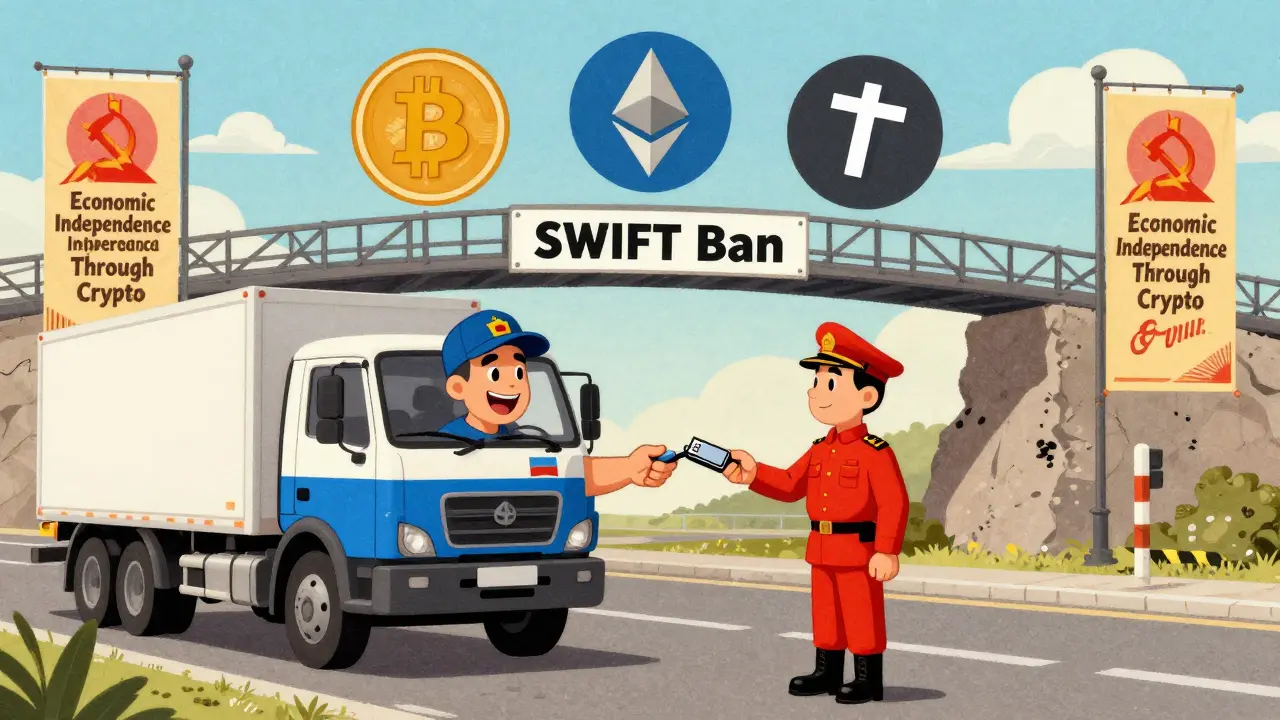
After 2022, Russia was cut off from the global financial system. Western payment networks like Visa, Mastercard, and SWIFT stopped working. Banks couldn’t process international payments. Businesses couldn’t pay suppliers abroad. Importers couldn’t get software, parts, or machinery. That’s when crypto became the only viable alternative.
Bitcoin, Ethereum, and USDT weren’t chosen because they were trendy. They were chosen because they worked. No banks. No intermediaries. No sanctions filters. Just direct peer-to-peer transfers. A small tech company in Novosibirsk could pay a developer in India using USDT in under 15 minutes. Before, that same payment through a bank took five days and cost 5% in fees. Now, it costs 0.3%.
By March 2025, the total value of cryptocurrency held in Russian exchange wallets hit 827 billion rubles-roughly $10.15 billion. That’s up 27% from just one year earlier. And according to Bank of Russia data, about 20 million Russians-13.6% of the population-are actively using crypto. Most of them aren’t traders. They’re workers, small business owners, and families trying to keep their lives running.
What Cryptocurrencies Russians Actually Use
Not all crypto is equal here. Bitcoin leads the pack, making up 62.1% of all holdings. Why? Because it’s the most recognized, the most liquid, and the most trusted for long-term value storage. Ether comes second at 22%, mostly used by those who interact with decentralized apps or need smart contracts for business automation.
But the real workhorse? Stablecoins-especially USDT and USDC. They make up 15.9% of holdings. These aren’t speculative bets. They’re digital cash. A Russian importer pays a Chinese factory in USDT. The factory gets paid in USD-equivalent value, instantly. No currency conversion. No delays. No bank fees. That’s why over 87% of users on Russian platforms rate crypto for cross-border payments as faster and cheaper than traditional methods.
And while global rankings show Russia at #10 for overall crypto adoption, its institutional ranking is #4. That means corporations, exporters, and logistics firms are using crypto more than individual investors. This isn’t a retail phenomenon-it’s an economic necessity.
The Legal Gray Zone
Russia’s official stance is a contradiction. The On Digital Financial Assets law, passed in 2021, says you can own crypto. But you can’t use it to pay for goods or services. So technically, you can hold Bitcoin. But if you try to buy a laptop with it, you’re breaking the law.
That’s why less than 0.5% of Russian businesses accept crypto as payment. Not because people don’t want to. But because the law says they can’t. A store owner in Kazan who tried accepting USDT for groceries got fined. A software firm in Yekaterinburg that paid freelancers in ETH was investigated. The message was clear: use crypto to move money across borders, but never as currency inside Russia.
It’s a strange reality. People use crypto every day for real economic activity, but the state pretends it doesn’t exist. The result? A thriving underground economy with no legal protections. Users report account freezes, sudden policy changes, and delays of up to three weeks during compliance reviews. One user lost 250,000 rubles in market opportunity because his exchange account was locked during a routine check.
How Russians Access Crypto Today
Before 2022, Russians used international exchanges like Binance and Kraken. Now? They’re blocked. So the market adapted.
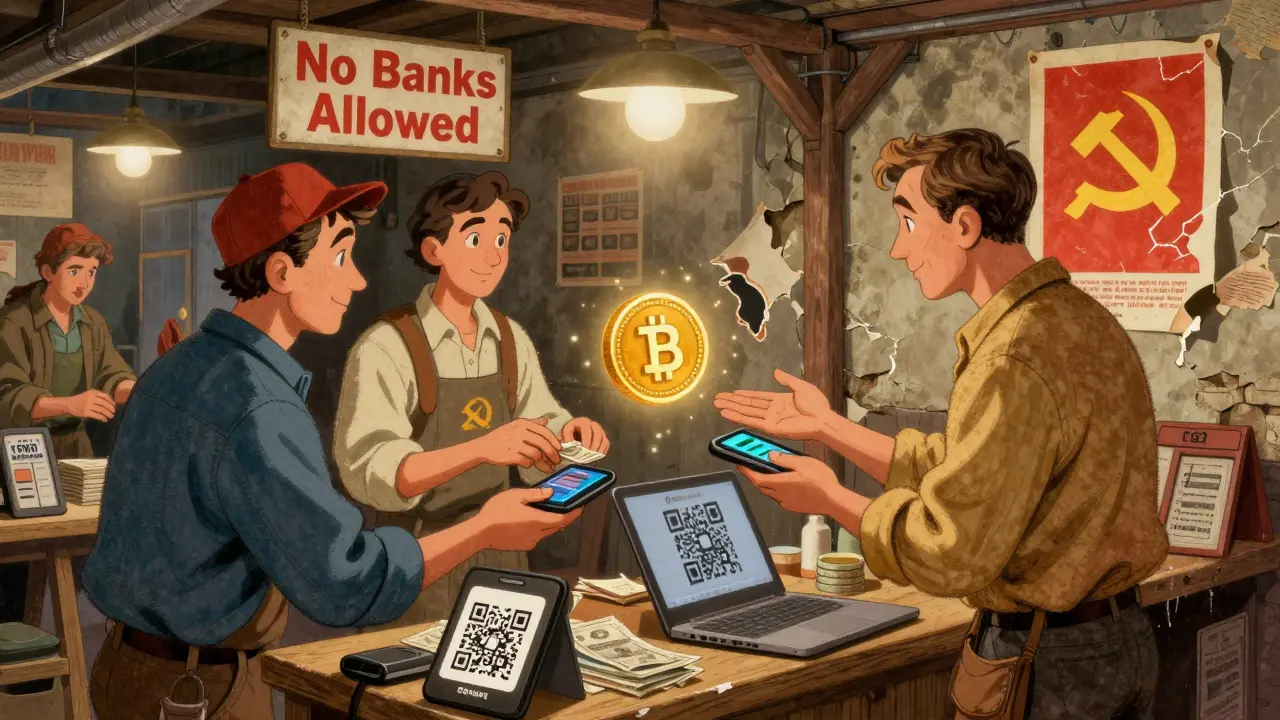
Domestic platforms like BitPrepay, EXMO, and Kuna.io now handle the bulk of trading. These are local, often smaller, and less regulated than global giants. They rely on peer-to-peer (P2P) networks. Users trade directly with each other-cash in hand, bank transfer, or even QR code payments at kiosks.
Identity verification takes 3-5 days. It’s slower than abroad, but it’s the only way to stay compliant. And even then, there’s no guarantee. The Bank of Russia has been known to shut down entire platforms overnight. Garantex, once Russia’s largest exchange, was sanctioned by the U.S. Treasury in 2022 and vanished. No warning. No explanation. Just gone.
That’s why most users now hold crypto in non-custodial wallets-like Trust Wallet or MetaMask. They control the keys. No exchange can freeze them. No regulator can seize them. It’s the only real security in this environment.
The Human Side: Stories from the Ground
On Reddit’s r/RussianCrypto, users share real experiences. One man from Rostov said he used Bitcoin to pay for medical equipment from Germany after his company’s bank account was frozen. Another woman in Samara uses USDT to send money to her sister in Armenia-no remittance fees, no delays, no questions asked.
Small businesses are adapting fastest. A software exporter in Perm started accepting USDT for contracts with clients in Indonesia and Vietnam. Transaction costs dropped by 40%. Revenue jumped. They didn’t need permission. They just did it.
But it’s not all success. Over 63% of negative reviews on Russian crypto platforms cite sudden policy changes. One user described being told his account was "under review" for three weeks, then suddenly closed without explanation. Another said his bank flagged his crypto purchases as "suspicious activity" and froze his entire savings account.
The emotional toll is real. People aren’t gambling. They’re protecting their livelihoods. And they’re doing it without legal backing, without insurance, and without recourse.
What’s Next? The Central Bank’s Shift
In October 2025, something changed. The Bank of Russia announced it would allow banks to handle cryptocurrency transactions-under strict capital and reserve rules. This isn’t legalization. It’s control.
The central bank is no longer denying crypto exists. It’s trying to bring it under its umbrella. Imagine a future where your Sberbank account lets you buy Bitcoin directly. But every transaction is monitored. Every withdrawal reported. Every transfer tracked.
The government is also preparing a major survey from January to February 2026 to map out how much crypto Russians hold, where it’s stored, and how it’s used. This isn’t curiosity. It’s preparation for regulation.
Deputy Finance Minister Ivan Chebeskov said it plainly: "Crypto is here. We must address it to secure economic and technological benefits." That’s the new tone. Not resistance. Not prohibition. Management.
Where Russia Stands Globally
Russia ranks #10 in the Chainalysis 2025 Global Crypto Adoption Index. Not bad for a country under sanctions. But look deeper:
- #8 for retail value received - strong individual usage
- #4 for institutional value received - corporations are leading
- #52 for DeFi value received - almost no use of decentralized finance
That last number is telling. Russians aren’t using DeFi protocols like Uniswap or Aave. They’re not staking or lending. They’re moving value across borders. That’s the only thing that matters in their reality.
Compared to other BRICS nations, Russia outpaces Brazil (#24) and China (not ranked). But it still trails India (#6), where crypto is more integrated into daily life. Russia’s adoption is raw, urgent, and transactional. It’s not about innovation. It’s about survival.
The Risks Ahead
There’s no safety net. No FDIC insurance. No consumer protection laws. If an exchange collapses, you lose everything. If the government changes its mind again, your assets could be frozen-or worse, confiscated.
The U.S. Treasury has already signaled it’s watching Russian crypto activity closely. New sanctions could target wallet providers, mining operations, or even P2P platforms. If that happens, the flow of crypto into Russia could dry up overnight.
And then there’s inflation. The ruble’s value has been volatile since 2022. Many Russians hold crypto not to get rich, but to avoid losing everything. Bitcoin isn’t an investment. It’s a shield.
Final Thoughts
Crypto adoption in Russia didn’t happen because of innovation. It happened because the system broke. And when the system breaks, people find their own way.
What’s happening in Russia is unique. No other country has seen such widespread, bottom-up adoption under such extreme pressure. This isn’t a crypto boom. It’s a financial emergency response.
The government may try to regulate it. The West may try to block it. But for now, millions of Russians are using crypto to stay connected-to their jobs, their families, and the world. And until the sanctions change, that won’t stop.
Is cryptocurrency legal in Russia?
Yes, but with major restrictions. Russian law allows citizens to own and trade cryptocurrency, but it is illegal to use it as payment for goods or services. This creates a legal gray zone where people use crypto for cross-border transfers and value storage, but not for everyday spending. The government is moving toward allowing banks to handle crypto transactions under strict rules, signaling a shift from prohibition to control.
How many Russians use cryptocurrency?
As of October 2025, approximately 20 million Russians-13.6% of the population-actively use cryptocurrency. This number has grown steadily since 2022, driven by international sanctions and the need for alternative financial tools. The Bank of Russia tracks this data through combined balances on cryptocurrency exchange wallets, which reached 827 billion rubles ($10.15 billion) in March 2025.
What cryptocurrencies are most popular in Russia?
Bitcoin is the most popular, making up 62.1% of holdings, followed by Ethereum at 22%. However, stablecoins like USDT and USDC are the most actively used, accounting for 15.9% of total holdings. Stablecoins are preferred for cross-border transactions because they maintain a stable value tied to the U.S. dollar, making them reliable for paying suppliers, freelancers, and importers abroad.
Can Russians use Binance or Coinbase?
No. International exchanges like Binance, Coinbase, and Kraken are blocked in Russia due to sanctions and regulatory restrictions. Russians now rely on domestic platforms such as BitPrepay, EXMO, and Kuna.io. These platforms operate on peer-to-peer models and require local identity verification. Many users avoid exchanges entirely and store crypto in non-custodial wallets like Trust Wallet or MetaMask to maintain full control over their assets.
Why is Russia ranked so high in crypto adoption despite sanctions?
Russia’s high ranking is driven by necessity, not choice. After being cut off from SWIFT and Western payment systems, Russians turned to crypto for cross-border payments, importing goods, and preserving wealth against ruble instability. Institutional adoption-especially by exporters and tech firms-is unusually strong, ranking #4 globally. This isn’t speculative trading; it’s economic survival. Chainalysis notes Russia’s adoption is among the most pragmatic in the world.
Jacque Istok
February 9, 2026 AT 00:58So let me get this straight - Russia’s citizens are using crypto because the system collapsed, but the government still fines people for accepting it as payment? That’s not a gray zone, that’s a farce. You can’t have your cake and eat it too, unless your cake is Bitcoin and you’re too scared to admit it’s working.
Molly Andrejko
February 11, 2026 AT 00:34It’s heartbreaking, really. People aren’t chasing gains - they’re just trying to pay for their kid’s medicine or send money to family abroad. No one should have to become a crypto expert just to survive. Maybe we need to stop calling it ‘adoption’ and start calling it ‘desperation’.
Alisha Arora
February 12, 2026 AT 20:24LMAO so now crypto is a survival tool? What about all the Russians who lost money on P2P scams? You think this is a revolution? Nah. It’s just a bunch of people trading cash for QR codes in parking lots. And now they’re gonna get raided. Mark my words.
Michael Sullivan
February 14, 2026 AT 00:56BITCOIN IS THE ONLY TRUTH 🌍🔥
SWIFT IS A DEAD SYSTEM. BANKS ARE A SCAM. RUSSIANS DID WHAT THE WEST REFUSED TO DO - THEY TOOK BACK FINANCIAL SOVEREIGNTY.
YOU CAN’T SANCTION A PEER-TO-PEER NETWORK. THEY’RE NOT A COMPANY. THEY’RE A MOVEMENT.
THEY’RE NOT BUYING LUXURY CARS. THEY’RE BUYING TIME. TIME TO LIVE.
Udit Pandey
February 15, 2026 AT 03:22It is a matter of great pride that Russia, under immense pressure, has demonstrated superior resilience and ingenuity. While the West clings to outdated financial systems, Russia has forged a new path - one rooted in self-reliance and technological sovereignty. This is not chaos. This is civilization evolving.
mahikshith reddy
February 15, 2026 AT 09:42USA and EU are crying because they can't control the money anymore. LOL. Russia didn't break. It just stopped playing their game. Crypto isn't illegal - it's justice.
Brendan Conway
February 15, 2026 AT 19:32man i just read this whole thing and i’m like… wow. these people aren’t trying to get rich. they’re just trying to not starve. and honestly? that’s more real than any crypto bro in Miami buying a meme coin.
orville matibag
February 16, 2026 AT 00:01As someone who’s lived in both India and the U.S., I’ve never seen a community adapt like this. No government support. No subsidies. Just people figuring it out. That’s the kind of innovation you can’t legislate.
Jesse Pasichnyk
February 16, 2026 AT 22:59Sanctions didn’t hurt Russia. They made it stronger. Crypto isn’t a loophole - it’s a middle finger. And guess what? It’s working.
Jordan Axtell
February 18, 2026 AT 13:29you ever feel like the whole world is watching you die and no one lifts a finger? that’s what this is. these people aren’t traders. they’re ghosts with wallets. and the banks? they’re just ghosts with more paperwork.
James Harris
February 19, 2026 AT 11:26There’s something beautiful here. People aren’t waiting for permission. They’re building. Not for profit. Not for fame. Just to keep living. That’s the kind of grit that changes history.
aryan danial
February 21, 2026 AT 03:42While the Western world remains trapped in the ideological shackles of centralized financial hegemony, Russia’s embrace of decentralized financial autonomy represents a paradigmatic rupture - one that transcends mere economic adaptation and enters the realm of post-national sovereignty. The blockchain, in this context, is not merely a technological tool - it is the ontological reassertion of human agency against institutional decay.
Danica Cheney
February 22, 2026 AT 16:17so like… crypto is legal to own but illegal to spend? wow. that’s so smart. i bet that works out great.
Kyle Pearce-O'Brien
February 23, 2026 AT 14:38Let’s be real - this isn’t adoption. It’s dislocation. Crypto is the digital equivalent of bartering goat skins for grain. The fact that it’s thriving under sanctions speaks volumes about the collapse of the Bretton Woods architecture - not about innovation. The West didn’t lose the war. It just stopped showing up.
Matthew Ryan
February 25, 2026 AT 05:58Interesting read. I’ve been following this for a while. The fact that institutions are leading adoption - not retail - is the real story. Most analyses miss that.
Nathaniel Okubule
February 25, 2026 AT 20:42Thank you for this comprehensive overview. It is clear that the Russian population has demonstrated remarkable adaptability in the face of unprecedented financial isolation. This case study may serve as a model for other nations facing similar constraints.
Robin Ødis
February 26, 2026 AT 20:20Let me tell you something. This isn't about crypto. This is about trust. When your bank freezes your account because you sent $500 to a freelancer in Ukraine - you stop trusting banks. You stop trusting governments. And you start trusting code. That's what's happening here. It's not a trend. It's a trauma response. And guess what? It's working. They're not rich. But they're not broke either. And that's more than the West can say for most of their middle class.