
Smart Contract Cost Estimator
Calculate Execution Costs
Results
Estimated Cost
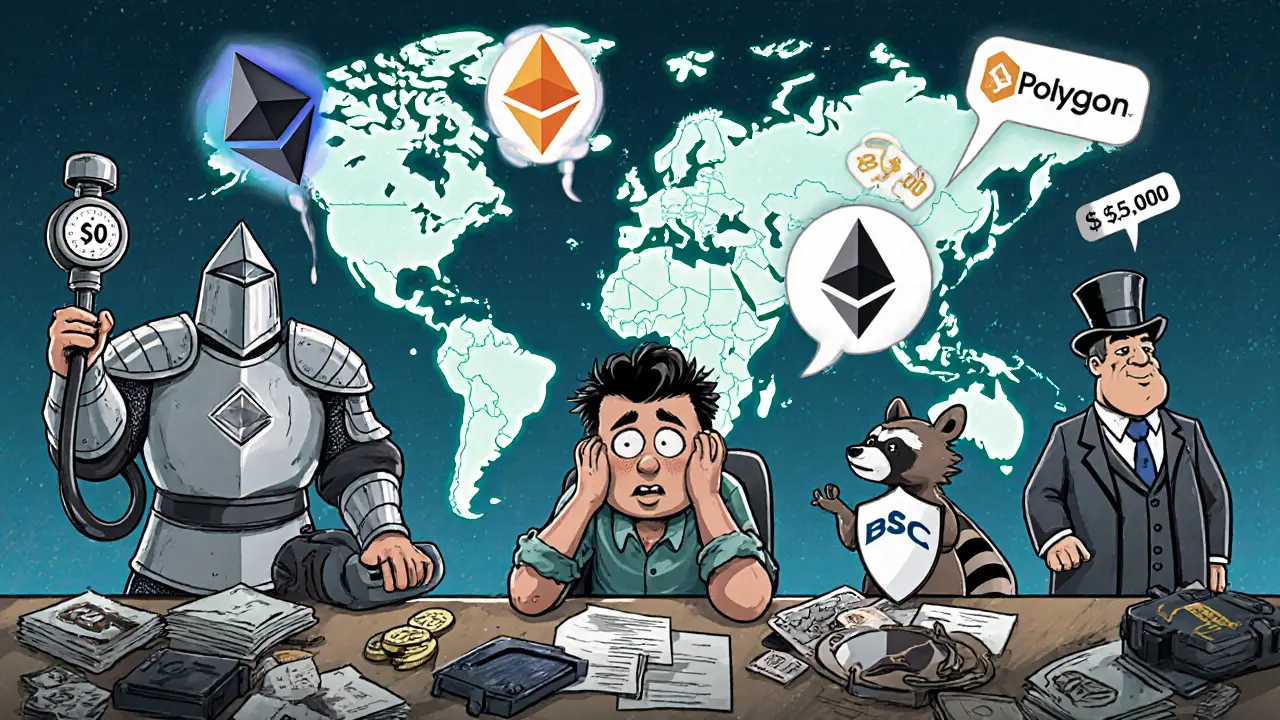
Running a smart contract isn’t free. Even if your code works perfectly, you still pay to get it executed on the blockchain. And that cost? It can range from less than a penny to over $100 - all depending on which network you pick. If you’re building a dApp, launching an NFT, or trying to automate payments, ignoring these fees will break your budget before you even get users.
Why Smart Contract Costs Matter More Than You Think
Smart contracts are self-executing programs on blockchains. They handle everything from token swaps to voting systems. But every time they run - whether it’s a simple transfer or a complex DeFi trade - the network needs to compute it. That computation costs money. This isn’t like paying a bank fee. It’s more like renting a supercomputer for a few milliseconds, and everyone on the network bids for that time.
Most developers think the cost is just about writing clean code. It’s not. The real issue is network congestion and consensus design. On Ethereum, when everyone rushes to mint an NFT, gas prices spike. On Solana, when the network gets overloaded, it crashes. On Hyperledger, you pay upfront for a private setup. Each choice comes with trade-offs.
According to Debut Infotech’s 2025 report, 62% of failed DeFi projects didn’t account for gas spikes. They built great tech - but users couldn’t afford to use it. That’s not a bug. It’s a business model failure.
Ethereum: High Cost, High Security
Ethereum is still the gold standard for secure, decentralized smart contracts. As of October 2025, average execution costs run between $5 and $50 per transaction. During peak times - like a big NFT drop or a DeFi token launch - that can jump to $150 or more.
Why so expensive? Ethereum uses proof-of-stake with over 8,800 active validator nodes. That’s a lot of computers verifying every operation. It’s slow, but it’s battle-tested. No major hacks. No outages. Just high fees.
Developers use Ethereum for high-value applications: DeFi protocols handling billions, institutional tokenization, and anything where security matters more than cost. Instagram’s early NFT system ran on Ethereum. So did the first major DAO. If your contract moves real money, Ethereum is still the default.
But here’s the good news: Ethereum’s Dencun upgrade in March 2025 slashed layer-2 costs by 90%. Rollups like zkSync and Arbitrum now run at $0.005 per transaction. So most users aren’t paying Ethereum mainnet fees anymore. They’re paying the layer-2 version. But if you deploy directly to mainnet? You’re still paying $5-$50.
Solana: Speed and Sub-Cent Fees - With Caveats
Solana’s the speed demon. Average transaction cost? $0.00025. That’s a quarter of a cent. It can handle 65,000 transactions per second. For gaming, microtransactions, or social tokens, it’s unbeatable.
How? Solana uses proof-of-history, a clever timing mechanism that lets nodes agree on order without constant communication. Less overhead = lower fees. It’s why 22.3% of all new gaming dApps chose Solana in Q3 2025, according to Cointelegraph.
But here’s the catch: Solana has had three major outages in 2025 alone, totaling over 17 hours of downtime. In May 2025, a single bot attack overloaded the network for six hours. Users couldn’t trade. Payments failed. Contracts froze.
Dr. Jane Chen from Calibraint put it bluntly: “Solana’s sub-cent fees make it unbeatable for microtransactions and gaming applications, but enterprises handling sensitive financial data still prefer Ethereum’s battle-tested security despite higher costs.”
If you’re building a game where users buy virtual skins every few minutes, Solana’s perfect. If you’re running a lending protocol that handles $100 million in collateral? You’re taking a big risk.
Polygon: The Smart Bridge to Ethereum
Polygon isn’t a competitor to Ethereum. It’s a sidekick. It runs on top of Ethereum, using its security but cutting costs to less than $0.01 per transaction. In Q2 2025, Polygon released its CDK stack, letting developers build custom chains with fees as low as $0.003.
That’s why so many NFT projects moved from Ethereum mainnet to Polygon. One Reddit user, u/EthereumBuilder, spent $12,000 deploying an NFT marketplace during a CryptoPunk mint. They switched to Polygon and cut their per-transaction cost to $0.007. User adoption jumped 300%.
Polygon processes 7,000 transactions per second - fast enough for most apps. It’s EVM-compatible, so developers don’t need to rewrite code. It’s the sweet spot: Ethereum’s trust, without the price tag.
But remember: Polygon inherits Ethereum’s security model. If Ethereum gets attacked, Polygon could be affected too. It’s not independent. It’s a shield, not a fortress.

Binance Smart Chain: The Cheap Alternative
Binance Smart Chain (BSC) offers near-identical performance to Ethereum but with fees under $1. It’s EVM-compatible, so tools like MetaMask and Remix work out of the box. It runs at 100 TPS - slower than Polygon or Solana, but enough for most apps.
It’s popular in Southeast Asia and Africa, where users are price-sensitive. Many DeFi apps started on BSC because it was cheap and easy. But here’s the problem: it’s centralized. Only 41 validator nodes control the network. Binance, the exchange, has heavy influence over them.
Rapid Innovation’s 2025 analysis called it “a high-performance network with low decentralization.” That’s fine if you’re trading tokens. Not fine if you’re handling legal contracts or government records. It’s a trade-off: cheap and fast, but not truly decentralized.
Hyperledger Fabric: Enterprise-Only, High Upfront Cost
Hyperledger Fabric isn’t for public blockchains. It’s for banks, governments, and big corporations. It’s permissioned - only approved parties can run nodes. That means no public gas fees. Instead, you pay for setup, maintenance, and support.
Deployment packages start at $25,000. Complex systems can cost $100,000. But once it’s running, your per-transaction cost is predictable. You don’t bid for gas. You pay a fixed monthly fee.
That’s why 41% of enterprise blockchain projects use Hyperledger, according to Deloitte’s 2025 survey. Banks use it for cross-border settlements. Supply chains use it to track shipments. The cost isn’t per transaction - it’s per contract.
Downsides? It’s complex. Setup takes months. Documentation is thin. Only 2,800 developers contribute to its community - compared to 45,000 for Ethereum. If you run into a problem, help is hard to find.
How to Reduce Smart Contract Costs (Even on Ethereum)
You don’t have to accept high fees. You can optimize.
- Minimize storage: Every time you write data to the blockchain, it costs 20,000-50,000 gas. Store only what’s necessary. Use off-chain storage (like IPFS) for images or documents.
- Use batch operations: Instead of running 10 transfers one by one, bundle them into one transaction. Saves up to 40% in gas.
- Choose the right contract structure: Modular contracts (like those from OpenZeppelin) cut deployment costs by 35-50%. Their code is optimized for gas.
- Use layer-2s: Deploy to Polygon, Arbitrum, or zkSync. Fees drop 80-95% compared to Ethereum mainnet.
- Time your deployments: Avoid weekends and major NFT drops. Use tools like Etherscan’s gas tracker to find low-fee windows.
OpenZeppelin’s gas-efficient library gets over 1,200 weekly clones. Developers are fixing this problem - one line of code at a time.
What Happens When Fees Spike?
In July 2025, a DeFi protocol saw transaction costs jump 40x during a market crash. Users tried to withdraw funds. Transactions failed. $2.3 million in user funds got stuck. Why? The contract didn’t have a fallback mechanism. It assumed fees would stay low.
This is why you need a cost buffer. Build in error handling. Let users pay more if needed. Offer gas fee subsidies. Or better yet - move high-frequency actions to a cheaper chain.
According to Gartner, developers who ignore gas optimization have a 62% failure rate. It’s not about coding skill. It’s about economics. Your app must be affordable to use.
Which Blockchain Should You Choose?
Here’s a quick guide:
- Use Ethereum mainnet only if you need maximum security and are okay with $5-$50 per transaction.
- Use Polygon for NFTs, social apps, and user-facing dApps. Best balance of cost, speed, and security.
- Use Solana for gaming, microtransactions, and high-frequency apps - if you can handle occasional outages.
- Use BSC if you’re targeting price-sensitive markets and don’t need full decentralization.
- Use Hyperledger only if you’re a corporation with legal teams and a $50,000+ budget.
There’s no “best” blockchain. Only the best fit for your use case.
Future Trends: Costs Are Falling - But Not Everywhere
By 2026, Gartner predicts 75% of enterprise blockchains will use hybrid fee models - fixed monthly fees plus small usage charges. That means predictable budgets.
Solana’s Firedancer client, launched in June 2025, pushed throughput to 100,000 TPS. If they fix the outages, it could dominate gaming and payments.
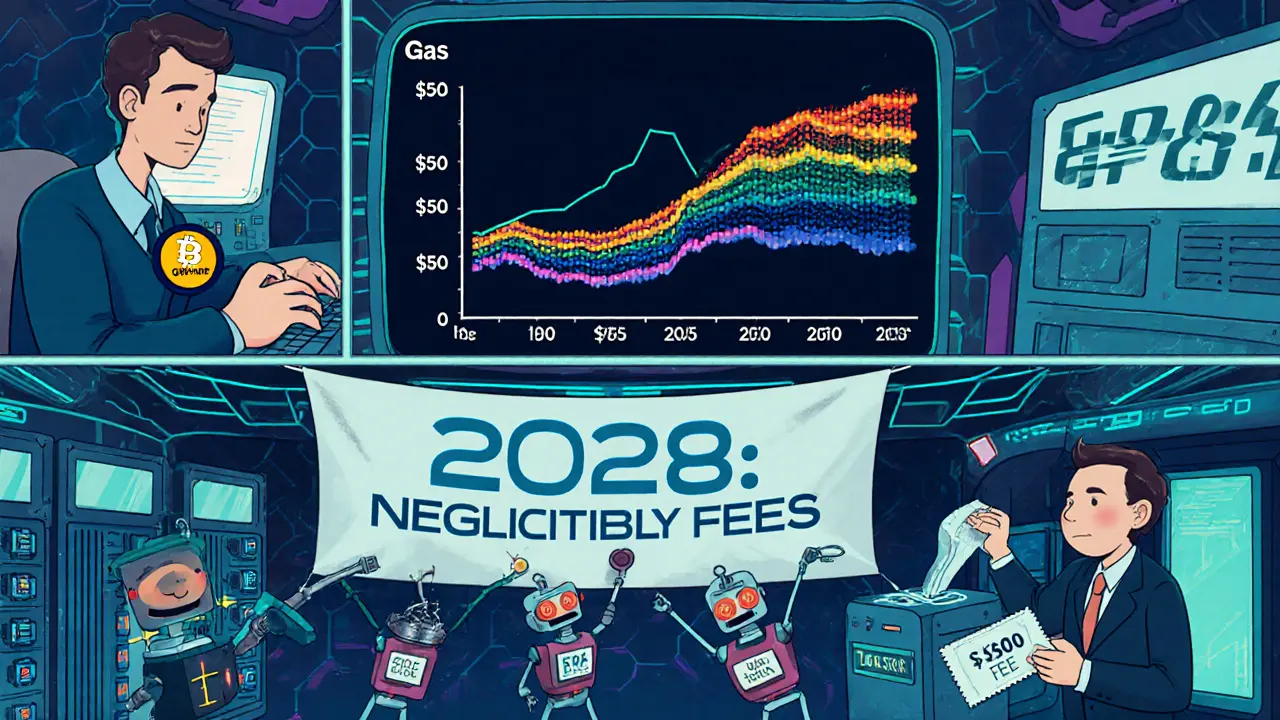
Forrester Research says smart contract fees will become “negligible” by 2028. That’s not hype. It’s math. As networks scale and tech improves, the cost per operation drops. We’re already seeing it with Ethereum’s layer-2s.
The real winners? Developers who learn to optimize. Users who pick the right chain. And businesses that treat gas fees as a core part of their product - not an afterthought.
How much does it cost to deploy a smart contract on Ethereum?
Deploying a basic smart contract on Ethereum mainnet costs between $50 and $300, depending on complexity and network congestion. Simple token contracts cost less. Complex DeFi protocols with multiple functions can cost over $1,000. Always test deployment costs on a testnet first.
Why is Solana cheaper than Ethereum?
Solana uses proof-of-history, a consensus method that reduces communication overhead between nodes. This allows it to process transactions faster and with fewer resources. Ethereum’s proof-of-stake requires more coordination and validation, increasing computational load and cost. Solana’s architecture is optimized for speed, not decentralization.
Can I avoid high gas fees on Ethereum?
Yes. Use layer-2 solutions like Polygon, Arbitrum, or zkSync. These run on top of Ethereum but cut transaction fees by 80-95%. Most new dApps now deploy to layer-2s and only use Ethereum mainnet for final settlement. You don’t have to pay Ethereum mainnet fees to benefit from its security.
What’s the cheapest blockchain for smart contracts?
As of 2025, Solana has the lowest average execution cost at $0.00025 per transaction. Polygon is the cheapest for Ethereum-compatible apps at under $0.01. For non-public, enterprise use, Hyperledger Fabric offers predictable pricing - but requires a $25,000+ upfront investment.
Do smart contract fees vary by time of day?
Yes, especially on Ethereum. Fees spike during peak usage: weekends, major NFT mints, or DeFi token launches. Weekdays between 2-6 AM UTC are usually the cheapest. Use tools like Etherscan’s gas tracker or Blocknative to find low-fee windows. Solana and Polygon have less variation, but even they can slow down during network congestion.
Are smart contract fees going down in 2025?
Yes, but unevenly. Ethereum’s layer-2s are getting dramatically cheaper thanks to EIP-4844 (proto-danksharding). Polygon’s CDK stack now allows fees as low as $0.003. Solana’s throughput is increasing. However, Ethereum mainnet fees remain high. The trend is clear: users are moving away from expensive chains. The future belongs to scalable, low-cost networks.
Angel RYAN
November 26, 2025 AT 22:25Just deploy to Polygon or zkSync and save your sanity.
Tom MacDermott
November 27, 2025 AT 11:16Susan Dugan
November 28, 2025 AT 18:38Stop optimizing for dev convenience. Optimize for human patience.
Sam Daily
November 29, 2025 AT 03:59Still worth it for us because our users mint 50 times a day. But I keep a backup deploy script on Polygon just in case. Never put all your eggs in one chain basket.
Shelley Fischer
November 30, 2025 AT 03:16Puspendu Roy Karmakar
December 2, 2025 AT 00:55Komal Choudhary
December 3, 2025 AT 23:02Wilma Inmenzo
December 4, 2025 AT 06:55priyanka subbaraj
December 5, 2025 AT 13:12George Kakosouris
December 7, 2025 AT 00:08Tony spart
December 9, 2025 AT 00:00Ben Costlee
December 10, 2025 AT 15:54It’s not about which chain is ‘best.’ It’s about which chain serves your users. That’s the real innovation.
Mark Adelmann
December 12, 2025 AT 08:34Switched from Ethereum mainnet to Polygon last year. My user retention jumped 4x. My dev stress dropped 90%. Game changer.
ola frank
December 12, 2025 AT 21:36imoleayo adebiyi
December 13, 2025 AT 05:57Vaibhav Jaiswal
December 15, 2025 AT 00:09Now I’m like… why am I even looking at Ethereum anymore?
Abby cant tell ya
December 15, 2025 AT 02:45Janice Jose
December 15, 2025 AT 14:45Savan Prajapati
December 17, 2025 AT 00:29Michael Labelle
December 18, 2025 AT 15:37Joel Christian
December 20, 2025 AT 14:20jeff aza
December 22, 2025 AT 10:28Ian Esche
December 22, 2025 AT 19:01Felicia Sue Lynn
December 24, 2025 AT 07:13Evelyn Gu
December 25, 2025 AT 13:31Michael Fitzgibbon
December 26, 2025 AT 18:14Tina Detelj
December 28, 2025 AT 02:20stephen bullard
December 28, 2025 AT 17:32Angel RYAN
December 30, 2025 AT 12:58