

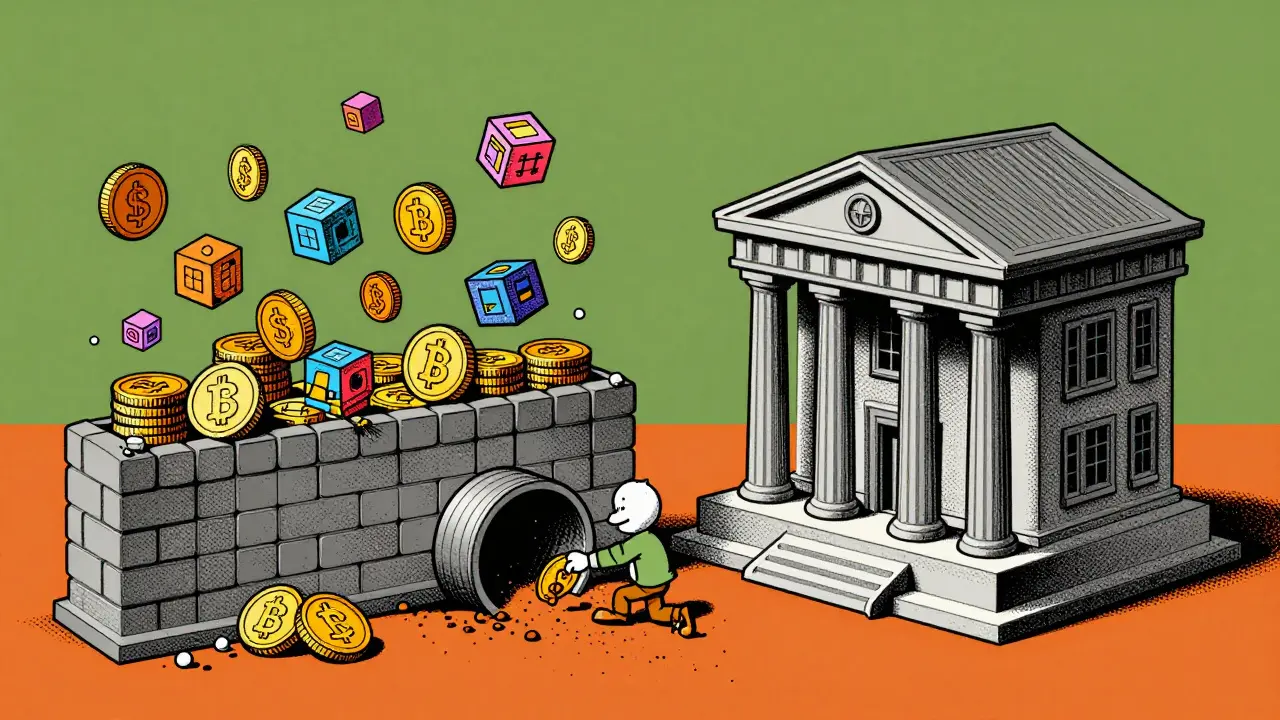
If you're trying to move money from a crypto exchange to a Colombian bank, you're fighting against a system designed to keep those two worlds separate. This isn't a total ban on owning crypto, but it is a strict ban on banks helping you manage it. For the average person, this means your bank cannot hold your coins, they can't invest in them for you, and they aren't allowed to facilitate the transactions.
How the Restrictions Actually Work
The SFC didn't just wake up one day and say "no crypto." This restrictive stance grew out of a 2022 public consultation that shifted the regulator's mood from cautious to restrictive. The core of the problem is that supervised financial institutions are explicitly prohibited from holding custody of cryptoassets. If a bank provides a wallet for you to store your assets, they are breaking the rules.
It goes deeper than just storage. Banks cannot offer investment products based on digital assets, and their platforms cannot be used to process crypto-related transactions. This creates a massive headache for anyone trying to "off-ramp" their gains. You might see your balance growing on an exchange, but the moment you try to send that money to a traditional account, you risk triggering a red flag.
To make things more complicated, the government is keeping a very close eye on the money that does move. Payment Service Providers (PSPs) are required to report any suspicious crypto transactions that exceed a threshold of USD 150 to the UIAF (Financial Information and Analysis Unit). This means if you're moving a few hundred dollars, the government likely knows about it, and they'll want to know exactly who sent it and who received it.
The Institutional Loophole: Wenia and COPW
You might be wondering: "If banks are banned from crypto, why is Bancolombia, one of the biggest banks in the country, involved in it?" This is where the story gets interesting. There is a clear difference between a bank's commercial wing and its subsidiaries.
Bancolombia managed to navigate the regulatory maze by launching Wenia a dedicated cryptocurrency exchange that operates under its own structure, separate from the main banking functions. Through Wenia, they've even introduced the COPW stablecoin. This proves that the "ban" isn't a ban on the technology, but rather a restriction on how traditional banking licenses are used.
For the average user, this creates a tiered system. Big players with the capital to build separate entities can bridge the gap, while the small-scale trader is left fighting with a bank manager who is terrified of the SFC.
Colombia vs. The Rest of Latin America
Colombia is taking a "middle-of-the-road" approach. They haven't gone full "El Salvador" by making Bitcoin legal tender, but they haven't gone full "ban" either. When you look at the neighbors, the contrast is sharp.
| Country | Banking Stance | Key Regulatory Action |
|---|---|---|
| Colombia | Strictly Restricted | SFC prohibits custody and facilitation |
| Brazil | Integrated/Taxed | Comprehensive crypto tax laws effective 2025 |
| Argentina | Accepted for Trade | Bitcoin recognized for international trade |
| Chile | Open/Laissez-faire | Approved multiple digital asset custodians |
| Mexico | Regulated Fintech | Fintech Law expanded to include custody |
While Brazil is focusing on how to tax the gains and Chile is letting custodians operate freely, Colombia is focused on risk management. The SFC is terrified of money laundering and terrorist financing, which is why they've prioritized reporting and restrictions over integration.
The Cost of Compliance and the "USD 150" Trap
For fintech companies and Virtual Asset Service Providers (VASPs), operating in Colombia is an expensive nightmare. The reporting requirements are brutal. Every single transaction over USD 150 requires full sender and recipient data capture. This isn't just a "check the box" exercise; it's a real-time monitoring requirement.
Failure to comply isn't just a slap on the wrist. Some PSPs have faced fines exceeding USD 1.5 million in a single year. This has led to a surge in RegTech adoption-software that automates audit trails and KYC (Know Your Customer) processes-just so these companies can survive the SFC's scrutiny.
For the user, this means your "private" transactions are anything but. If you're using a local provider to cash out, expect a lot of questions and a lot of paperwork. If you can't provide the source of funds, the provider will likely block your account to avoid a million-dollar fine.

Will the Ban Ever Lift?
There is a glimmer of hope. Minister of Finance Ricardo Bonilla has admitted that cryptocurrencies are a "reality" and that there is a genuine interest in regulating them properly. However, there is one non-negotiable rule: the Central Bank of Colombia must maintain its autonomy and remain the only entity with the power of primary issuance. They aren't about to let a decentralized asset undermine the national currency's authority.
The future likely lies in something like the Bre-B payment platform. If the government can find a way to integrate digital assets without giving up control of the monetary policy, we might see the banking ban soften. But for now, we are in a period of "cautious observation." The SFC is watching global exchange failures and crashes, using them as justification to keep the barriers high.
Survival Guide for Crypto Users in Colombia
If you're navigating this landscape, you need a strategy to avoid getting your accounts flagged. Here are a few rules of thumb based on current regulatory behavior:
- Avoid Large, Unexplained Transfers: Since the USD 150 threshold is a trigger for reporting, sudden large deposits from unknown exchanges are a recipe for a frozen account.
- Keep Impeccable Records: Treat your crypto like a business. Keep screenshots of trades, wallet addresses, and timestamps. If the bank asks for the source of funds, you need to provide a paper trail immediately.
- Use Regulated On-Ramps: While tempting to use P2P markets, using established platforms like Wenia (which has already cleared the regulatory hurdles) is generally safer for your banking relationship.
- Understand the Tax Man: Remember that the banking ban doesn't mean a tax ban. Digital assets are treated as intangible assets. You're still expected to report capital gains under existing income tax laws.
Is it illegal to own Bitcoin in Colombia?
No, it is not illegal to own or trade cryptocurrency in Colombia. The "ban" specifically applies to supervised financial institutions (banks), meaning they cannot provide services like custody, investment, or direct transaction facilitation for cryptoassets.
Why do Colombian banks freeze accounts linked to crypto?
Banks are under strict orders from the SFC to prevent money laundering and terrorist financing. Because crypto transactions are often seen as high-risk, banks may freeze accounts that show patterns consistent with crypto-exchanges to avoid heavy regulatory fines.
What is the USD 150 reporting limit?
Payment Service Providers (PSPs) in Colombia are required to report suspicious cryptocurrency transactions exceeding USD 150 to the UIAF. This includes capturing full identity and account details for both the sender and the recipient.
Can I use Wenia safely?
Wenia is an exchange launched by Bancolombia, designed specifically to operate within the legal framework. Because it is a dedicated entity rather than a direct banking service, it provides a more regulated and compliant path for users to engage with digital assets.
Do I have to pay taxes on my crypto in Colombia?
Yes. The Colombian government treats digital assets as intangible assets. Any profits made from trading or business activities involving crypto are subject to personal or corporate income tax under existing frameworks.
Caiaphas Konkol
April 23, 2026 AT 19:07Typical state apparatus behavior, pretending to care about "risk" while they just want a total stranglehold on every single cent you move. The $150 limit is a joke-it's clearly designed to map out every individual's financial footprint under the guise of stopping terrorists. They aren't afraid of the coins, they're afraid of a system they can't tax or track with a spreadsheet.
Kyle Bush
April 24, 2026 AT 19:26Absolutely pathetic! 😡 Why would anyone want to invest in a place that treats its own citizens like criminals just for using tech? Keep your money in the US where we actually know how to handle business! 🇺🇸💪🇺🇸
Jason M
April 25, 2026 AT 05:49Listen, this is a massive learning opportunity for anyone in the region! It's an absolute tragedy that the average person is caught in the crossfire, but we can overcome this by educating ourselves on the specifics of the SFC guidelines! You've got to be proactive, document everything, and stay resilient in the face of this bureaucratic nightmare! 🚀
Keith Garcia
April 27, 2026 AT 03:13The sheer audacity of the SFC to wrap their stifling incompetence in the cloak of "risk management" is truly a masterclass in governmental gaslighting 🙄. It's quite quaint that they think a few million-dollar fines will actually deter the savvy, while the plebeians are left to suffer the indignity of frozen accounts. Simply pedestrian 💅✨.
Gloris Young
April 29, 2026 AT 02:59Keep your head up everyone! Just take it slow. 🌸
Tony Gurley-Ward
April 29, 2026 AT 22:57Isn't it funny how we call it "decentralized" finance but the moment we want to buy a sandwich with it, we're begging for permission from a guy in a suit at a bank? It's a beautiful paradox of our modern age, really. We're basically digital nomads fighting a war against paper clip bureaucrats!
Matthew Morse
April 30, 2026 AT 23:17who even cares honestly just use p2p and stop complaining
Yvette P
May 2, 2026 AT 07:49Oh, look at us, pretending that the SFC's "risk management" isn't just a thinly veiled attempt to maintain a legacy fiat hegemony while they desperately try to integrate a CBDC through the back door. It's just so precious that people think a $150 threshold is for "security" when we all know the liquidity providers are basically just acting as unpaid informants for the government to ensure the systemic risk of an unmonitored capital flight doesn't trigger a total macroeconomic collapse of the peso. I mean, really, if you think the institutional loophole of Wenia is a "bridge" for the common man, you're just drinking the corporate Kool-Aid while the regulators laugh at your naive belief in a tiered system that only benefits the top 0.1% of the financial elite who already have the legal counsel to bypass these absurdities. It's almost impressive how they've managed to create a regulatory environment that is simultaneously restrictive and completely porous for the wealthy, essentially creating a legalized shadow-banking system that renders the "ban" a mere inconvenience for the elite and a crushing weight for the small-scale retail trader who just wants to diversify their portfolio without being flagged as a global threat to national security. Absolutely brilliant strategy if your goal is to maximize inequality while maintaining a facade of compliance!
Jagdish Sutar
May 4, 2026 AT 03:38It is very interesting to see how different countries handle this. In India, we have our own complexities, but the idea of a separate entity like Wenia is a clever way to bridge the gap without risking the main bank's license.
Mike Krasner
May 5, 2026 AT 17:02everyone is just pretending the banks aren't already stealing our money through inflation anyway lol
Ali Tate
May 7, 2026 AT 10:44Exactly! The banks are just dinosaurs trying to eat the comet. Who cares about a few regulations when the whole system is a joke compared to the US market anyway
Liz Ariza
May 9, 2026 AT 08:00That sounds so stressful for the people there 😭 definitely keep those records tidy! ✨
Clair Geary
May 10, 2026 AT 08:05this is such a wild situation honestly... i wonder how many people are actually using the p2p stuff and just hoping for the best without any paper trail
Alex Hunter
May 10, 2026 AT 10:15The most important thing here is the documentation. If you can prove where the money came from, you're halfway to safety. Don't let the fear paralyze you, just be methodical.
Sarah Ingrams
May 11, 2026 AT 07:49so scary for the small traders
Doc Coyle
May 13, 2026 AT 04:06It is simply a matter of law. If the SFC deems the risk too high, the banks must comply or lose their license. It's not a conspiracy, it's basic regulation.
Hannah Rubia
May 14, 2026 AT 04:41One might suggest that the use of stablecoins like COPW could provide a more stable transition period for users who are hesitant to engage with the volatility of Bitcoin while still avoiding the direct restrictions of traditional banking.
Tara Aman
May 16, 2026 AT 03:43I totally agree with the survival guide tips! Let's all help each other stay safe and compliant! 🌟
Jennifer L
May 18, 2026 AT 03:18Oh my goodness, the thought of having an account frozen is just horible... I truly hope people find a way to protect their savings without too much trouble!!
Lisa Camp
May 19, 2026 AT 06:19JUST USE A HARD WALLET AND STOP WORRYING ABOUT THE BANKS! STOP BEING AFRAID OF THE SYSTEM AND TAKE CONTROL OF YOUR ASSETS!
Charlie Queen
May 20, 2026 AT 18:44It's a tough spot to be in, but I love how Colombia is at least trying to find a middle ground. 🇨🇴 Every country is just figuring this out as they go! 🌍✨
Mary Tawfall
May 22, 2026 AT 00:31I'm sure things will improve as the technology becomes more accepted. There is always a way forward if we stay positive and patient.
debashish sahu
May 23, 2026 AT 17:40The reporting requirements for PSPs are quite stringent. It creates a significant barrier to entry for new fintech startups in the region.
Mike Word
May 25, 2026 AT 04:19The contrast with Brazil's approach is quite telling. Focusing on taxation rather than prohibition usually leads to better integration in the long run.
Ellie Drews
May 26, 2026 AT 17:55It's definitely a tricky balance to maintain. Just remember to be kind to yourselves while navigating these rules!