
Have you ever clicked on an ad for a crypto exchange that promised "the world's first entity digital economy token trading platform"? It sounds impressive until you try to find out what that actually means. That is exactly the situation with BTLUX, a Singapore-based cryptocurrency exchange founded in 2017 that offers spot and leveraged trading services. As we move through 2026, the crypto landscape is more crowded than ever. You have giants like Binance and Coinbase, plus specialized derivatives platforms like BitMEX. Where does BTLUX fit in? The short answer is: it’s complicated.
If you are looking for a place to trade Bitcoin or Ethereum with high leverage, BTLUX might catch your eye because of its marketing. But if you are looking for a wide selection of altcoins, deep liquidity, or transparent security audits, you might hit a wall. This review cuts through the buzzwords to look at the actual features, risks, and usability of the platform so you can decide if it deserves a spot in your portfolio.
The Core Problem: Limited Coin Selection
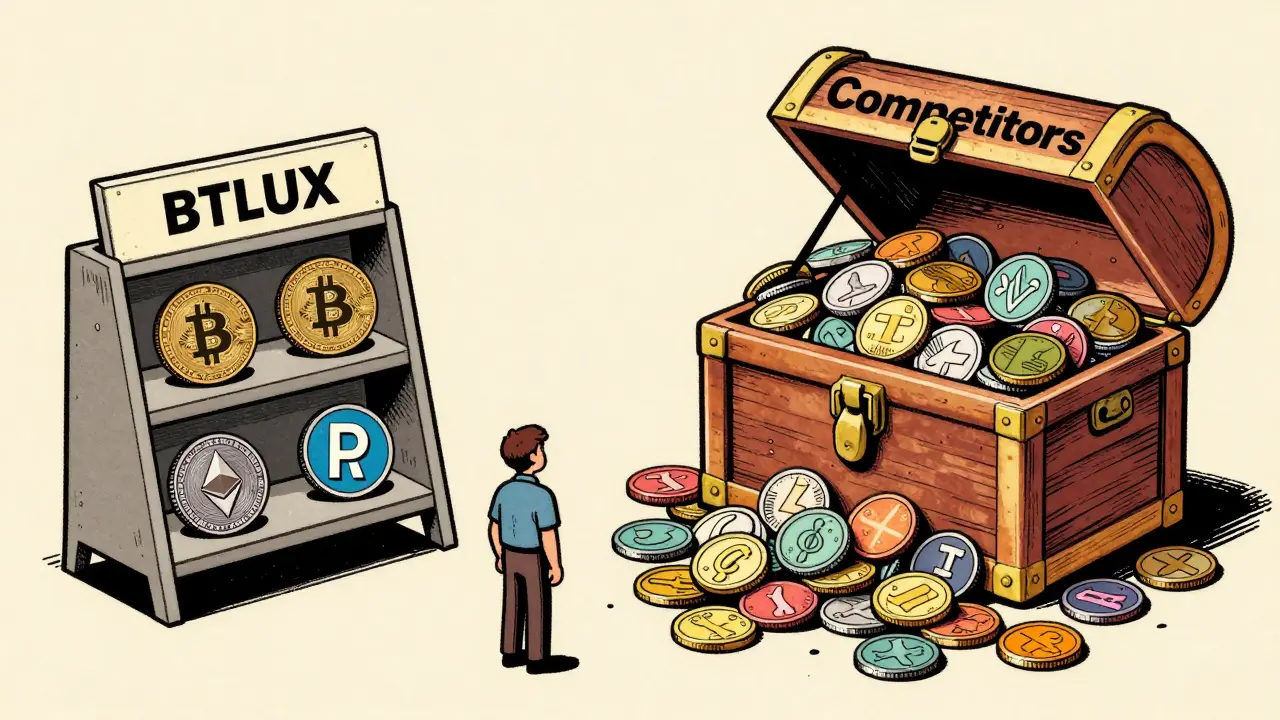
Let’s start with the most obvious issue for any trader: what can you actually buy? When you sign up for BTLUX, you are greeted with a very small menu. The platform primarily supports four major cryptocurrencies:
- Bitcoin (BTC)
- Ethereum (ETH)
- Litecoin (LTC)
- Ripple (XRP)
That’s it. Four coins. Compare this to competitors like Gate.com, which lists over 3,500 cryptocurrencies, or even mid-tier exchanges that offer hundreds of pairs. If your strategy involves diversifying into emerging DeFi tokens, NFT projects, or new Layer-1 blockchains, BTLUX simply cannot help you. You would need to maintain accounts on multiple platforms just to access the broader market.
This limitation suggests BTLUX targets a specific niche: beginners who only want to trade the "big four" or conservative investors who avoid volatile altcoins. For anyone else, the lack of variety is a significant dealbreaker. Why would you pay fees on one exchange when another gives you access to thousands of assets?
Leverage Trading: Conservative by Design?
BTLUX markets itself as offering leveraged trading, which allows you to borrow funds to increase your potential returns. However, the maximum leverage ratio on BTLUX is capped at 1:10. In the world of crypto derivatives, this is considered quite low. Platforms like BitMEX often offer leverage up to 100x or more for experienced traders.
Is lower leverage good or bad? It depends on your risk tolerance. A 1:10 limit means you are less likely to get liquidated instantly during minor price swings. This makes BTLUX potentially safer for newcomers who might blow up their accounts on higher-leverage platforms. However, professional traders seeking maximum exposure will find the 10x cap restrictive. Furthermore, while the leverage is limited, the transparency around how these positions are managed is not. Unlike BitMEX, which publishes regular Proof of Reserves and details its cold wallet infrastructure, BTLUX provides vague information about its fund protection protocols.
Regulatory Claims vs. Reality
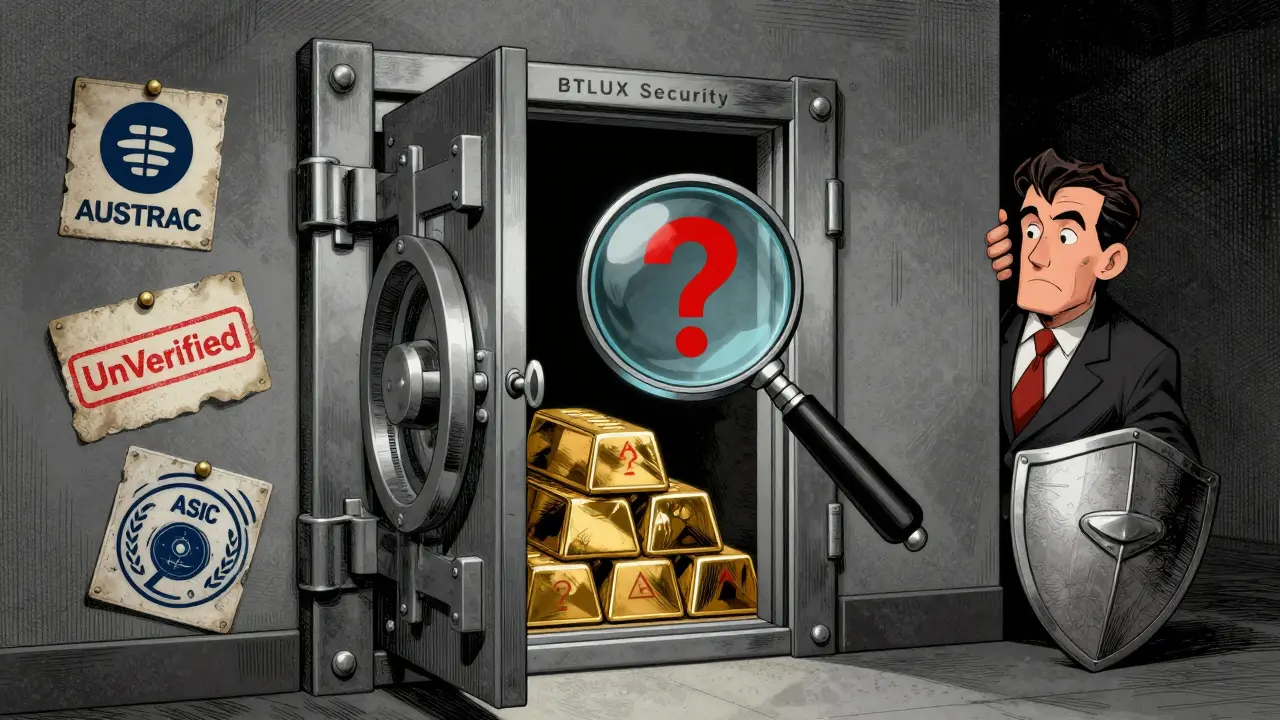
One of BTLUX’s main selling points is its regulatory status. The platform claims to hold licenses from several major financial authorities, including:
- Australian Transaction Reports and Analysis Centre (AUSTRAC)
- Australia Securities & Investment Commission (ASIC)
- Financial Transactions and Reports Analysis Centre of Canada (FINTRAC)
- Financial Crimes Enforcement Network (FinCEN) in the US
On paper, this looks robust. However, independent review sites like WikiBit have noted these statuses as "Exceeded" or unverified. In the crypto industry, claiming a license is easy; proving active compliance is hard. Many smaller exchanges list regulatory bodies they have registered with but may not be actively audited by them. Without clear, public documentation of current compliance certificates, you should treat these claims with caution. Established exchanges like Independent Reserve in Australia operate with clear ISO 27001 certification and audited segregated funds since 2013. BTLUX lacks this level of verifiable transparency.
User Experience and Platform Features
In recent years, BTLUX launched a "2.0" upgrade, promising to maximize blockchain value transmission. Unfortunately, the specifics of this upgrade remain unclear. There are no detailed changelogs or feature breakdowns available to users. What we do know is that the platform operates via web browsers and mobile apps for both iOS and Android.
The interface appears designed for simplicity, which aligns with its limited coin selection. For beginners, this can be a pro-fewer buttons mean fewer mistakes. However, advanced traders will miss key tools like custom charting overlays, API trading bots, and depth-of-market analysis. The educational resources provided include video tutorials and webinars, which is a nice touch for novices trying to understand basic trading concepts.
| Feature | BTLUX | Gate.com | BitMEX |
|---|---|---|---|
| Coin Selection | 4 Major Coins | 3,500+ Assets | 100+ Derivatives |
| Max Leverage | 1:10 | Varies (up to 100x) | Up to 100x+ |
| Regulatory Transparency | Claims Multiple Licenses (Unverified) | Global Compliance Focus | Strict KYC/AML |
| Security Proof | No Public Audits | Regular Proofs | Proof of Reserves |
| Target Audience | Beginners / Conservative Traders | Altcoin Hunters | Professional Traders |
Deposits, Withdrawals, and Fees
Getting money in and out of BTLUX is relatively straightforward. The platform supports bank transfers, credit/debit cards, and various e-wallet solutions. This flexibility is helpful if you don’t already hold cryptocurrency elsewhere. However, the fee structure is not clearly detailed in public documentation. Most exchanges charge a spread on card deposits and a percentage fee on trades. Without transparent fee schedules, it is difficult to calculate the true cost of trading. High hidden fees can eat into profits, especially with the limited leverage options available.
Security Concerns
This is the most critical section for any crypto investor. Security is not just about having a firewall; it is about trust. BTLUX does not publish comprehensive security disclosures. We do not see details on cold storage percentages, multi-signature wallets, or insurance funds for user assets. In contrast, major exchanges regularly undergo third-party security audits and share these results publicly. The absence of this information is a red flag. If you deposit $10,000 into BTLUX, how do you know it is safe? Currently, there is no public evidence to assure you beyond their marketing claims.
Who Should Use BTLUX?
Based on the available data, BTLUX serves a very narrow demographic. It might be suitable for:
- Absolute Beginners: Users who only want to buy Bitcoin or Ethereum and are intimidated by complex interfaces.
- Conservative Traders: Those who want slight leverage (1:10) without the extreme risk of 100x contracts.
- Regional Users: Individuals in Singapore or Australia who prefer a local-facing platform, despite the regulatory ambiguities.
It is not suitable for:
- Altcoin Investors: You will find nothing but the big four coins.
- High-Frequency Traders: Lack of API tools and advanced charting.
- Risk-Averse Savers: Lack of transparent security audits and proof of reserves.
Final Verdict
In 2026, the crypto exchange market demands transparency, variety, and proven security. BTLUX struggles to meet these standards. While its simple interface and limited leverage might appeal to some beginners, the lack of coin diversity, vague regulatory status, and missing security disclosures make it a risky choice for serious capital. If you are determined to use BTLUX, start with a very small amount to test withdrawals before committing significant funds. For most users, established exchanges with clear audit trails and broader asset selections offer a safer and more versatile experience.
Is BTLUX a legitimate exchange?
BTLUX is a registered company based in Singapore, founded in 2017. However, its legitimacy is questioned due to unverified regulatory claims and a lack of transparent security audits. While it operates legally, users should exercise caution regarding fund safety compared to larger, audited exchanges.
What cryptocurrencies can I trade on BTLUX?
BTLUX currently supports only four major cryptocurrencies: Bitcoin (BTC), Ethereum (ETH), Litecoin (LTC), and Ripple (XRP). It does not offer altcoins, stablecoins, or newer blockchain tokens.
Does BTLUX offer high leverage trading?
No, BTLUX caps leverage at 1:10. This is significantly lower than competitors like BitMEX, which offer up to 100x or more. This makes BTLUX less attractive for professional derivatives traders.
How secure are my funds on BTLUX?
There is limited public information regarding BTLUX’s security measures. Unlike major exchanges, BTLUX does not publish regular Proof of Reserves or detailed cold storage protocols. This lack of transparency poses a higher risk for large deposits.
Can I use BTLUX in Australia or Canada?
BTLUX claims licensing with AUSTRAC (Australia) and FINTRAC (Canada). However, these claims are marked as "Exceeded" or unverified by independent reviewers. Users in these regions should verify current compliance status directly with the respective regulatory bodies before using the platform.
Terry Hyland
June 18, 2026 AT 16:26these crypto scammers are just thieves with fancy websites. they steal your money and then hide behind some fake license from a country nobody cares about. it is all a lie designed to make you feel safe while they drain your wallet. i have seen this happen too many times and people still fall for it because they are greedy and stupid. the whole industry is built on deception and fraud.
Monica Pathammavong
June 20, 2026 AT 10:16u guys dont even read the fine print lol. btlux says they are licensed but wiki bit says exceeded?? that means nothing to u but everything to me who actually knows how regs work. its like saying ur dog is trained cause he sits once. also why only 4 coins? lazy devs probably cant code more pairs so they cap leverage at 10x to hide their slippage issues. typical sh*tcoin exchange behavior.
Akeem Whittaker
June 21, 2026 AT 12:37We need to look at the structural integrity of these platforms before depositing funds. The lack of API support and advanced charting tools suggests that BTLUX is not built for serious traders. It appears to be a simplified interface for those who do not understand market dynamics. I recommend sticking to exchanges with proven track records and transparent security audits.
Manish Prajapat
June 21, 2026 AT 15:36The philosophical implication of limiting choice to four assets is profound. It forces a homogenization of risk that may seem safe but ultimately concentrates exposure in ways that are not immediately obvious. We must consider whether simplicity serves the user or merely the platform's operational ease. In a world of infinite possibilities, restricting oneself to the 'big four' feels like an arbitrary constraint imposed by design rather than necessity.
John Doe
June 22, 2026 AT 06:30I can't believe how much trust people put into these unverified claims! It’s heartbreaking to see individuals risking their life savings on platforms that don’t even publish proof of reserves. Imagine waking up one day to find your account frozen with no explanation. That level of vulnerability is terrifying for anyone who has worked hard for their money. Please protect yourselves!
Mekz Wheoki
June 23, 2026 AT 03:12Oh wow, another review of a platform that barely exists. Congratulations on discovering that BTLUX has four coins. Groundbreaking journalism. I suppose the next article will be about how water is wet and sky is blue. If you want to trade, go anywhere else. This place is a digital ghost town with a marketing budget.
Skm Shubham
June 23, 2026 AT 21:53Let us analyze the regulatory claims critically. Claiming AUSTRAC and FINTRAC registration does not equate to active compliance or safety. Many entities register as MSBs to satisfy basic legal requirements without undergoing rigorous audits. The absence of public security disclosures is a significant red flag that indicates either incompetence or malicious intent. Users should treat such platforms with extreme skepticism.
Rob Aronson
June 25, 2026 AT 15:17From a risk management perspective, the lack of cold storage transparency is unacceptable 🚩. Institutional investors require verifiable proof of reserves (PoR) to mitigate counterparty risk. Without multi-signature wallet details or third-party audit trails, the probability of fund misappropriation increases exponentially. Do not expose your capital to such undefined systemic risks 📉.
Kwon Bill
June 26, 2026 AT 20:59In the broader context of global fintech adoption, platforms like BTLUX represent a transitional phase where local regulations clash with international standards. While they claim compliance with bodies like FinCEN, the actual enforcement mechanisms vary significantly across jurisdictions. For cross-border traders, this ambiguity creates friction that larger, globally integrated exchanges have already resolved through standardized KYC/AML protocols.
Danna Charris
June 27, 2026 AT 19:54Simply put, if you cannot afford the fees on Coinbase, you should not be trading crypto. BTLUX is for people who think 10x leverage is high risk. It is adorable. Real traders know better. Stay away unless you enjoy losing money slowly.
Fede Faith
June 29, 2026 AT 17:36I’ve been in the space since 2017, and seeing a platform with only four coins in 2026 is baffling. If you are new, start small, yes, but do not let them lock you into a walled garden. Learn how to use hardware wallets and move your assets off-exchange. Safety comes from self-custody, not trusting a website with vague security claims.
Josh Dodson
July 1, 2026 AT 12:23hey man i totally get why ppl use it for simple stuff but cmon only 4 coins? thats crazy low. i tried it once and felt like i was stuck in 2013. just use binance or something u wont regret it. easy peasy.
Suman Patil
July 2, 2026 AT 15:19Let's keep the vibe positive here, folks! Everyone starts somewhere. If BTLUX helps beginners learn the ropes without getting overwhelmed by complex charts, that is a win. However, we must encourage growth. Once you are comfortable, explore other platforms with better liquidity and more asset variety. Keep learning and stay safe out there!
Kumaran sowkarpet
July 4, 2026 AT 12:00namaste friends :) i think for indian users especially, we need to be careful with tax implications too. btlux might not report correctly to our authorities. always check local laws before trading. happy investing everyone 🙏
Mauricio Contreras Loredo
July 6, 2026 AT 07:35Sure, sure, it's 'safe' for beginners. Because nothing says safety like a platform that doesn't tell you where your money is kept. Oh wait, they don't tell you anything. Classic. Just what we needed, another black box pretending to be a bank.
sreeja boora
July 7, 2026 AT 18:29As a citizen of India, I am deeply concerned about the lack of clear regulatory alignment with Indian financial standards. Platforms operating without proper RBI approval pose significant risks to our economy. We must prioritize domestic exchanges that adhere strictly to our national laws and protect our citizens from foreign speculative ventures.
Grace Newman
July 8, 2026 AT 20:25One must consider the possibility that these 'unverified' licenses are part of a larger scheme to launder illicit funds under the guise of legitimate trading. The opacity surrounding their security protocols is not an oversight; it is a feature. They are hiding something, and until they provide irrefutable evidence of solvency, they should be treated as hostile entities.
Annemarie Fitzgerald
July 9, 2026 AT 22:46the existential dread of logging into an exchange that might cease to exist tomorrow is palpable. is my btc real or just numbers on a screen controlled by some anon dev in singapore? i dont know anymore. maybe the matrix is just btlux and we are all trapped in its 4 coin prison. scary thoughts really.
Abby Sivertsen
July 11, 2026 AT 06:00Look, I get it, simple is good. But when simple means 'we don't show you our books,' that's a problem. I've been burned by 'simple' platforms before. Don't be that person. Demand transparency. If they can't show you proof of reserves, walk away. It's that simple.
Benjamin Eisen
July 12, 2026 AT 00:37i was thinking about trying this for my dad who is super cautious. but reading this makes me nervous. maybe i should just teach him to use a hardware wallet instead? any tips on how to explain seed phrases to older folks without confusing them?
Kenneth Riley
July 13, 2026 AT 02:12you think this is bad? wait till you see what happens when the SEC actually cracks down on these flyby night operations. they will vanish overnight leaving thousands of victims holding worthless IOUs. its not a matter of if but when. stop feeding the beast you fools.