

Quick Takeaways
- Who needs it: Anyone receiving, transmitting, storing, or exchanging virtual currency for New York residents.
- The Cost: High. Expect $150k+ in upfront costs and millions in total legal and compliance spend.
- Capital Requirements: Typically between $1 million and $5 million depending on your risk profile.
- Timeline: Be patient; the application process usually takes 12 to 18 months.
- Key Benefit: Legal access to New York's massive financial ecosystem and increased consumer trust.
What counts as "Virtual Currency Business Activity"?
You can't just ignore the BitLicense requirements because you're a "tech company." If your operations touch New York residents, the NYDFS (New York State Department of Financial Services) wants to know about it. According to the regulations in 23 NYCRR Part 200, you need a license if you do any of these five things:
- Receiving virtual currency for transmission or transmitting it on behalf of someone else.
- Storing, holding, or maintaining custody of coins (acting as a custodian).
- Buying and selling virtual currency as a customer-facing business.
- Operating an exchange service for customers.
- Controlling, administering, or issuing a virtual currency (like launching a token).
If you fit any of these descriptions, you are essentially operating a financial institution in the eyes of New York. This is why the rules feel so similar to traditional banking laws-because they are.
The Heavy Lifting: Capital and Financial Requirements
New York doesn't let you "move fast and break things" with people's money. They require a significant financial cushion to ensure that if your business hits a snag, your customers aren't left empty-handed. First, there is the base capitalization. Depending on your scale, you'll need a minimum of $1 million to $5 million in liquid capital. This isn't just a number on a spreadsheet; it's a requirement to ensure the business can handle operational risks without collapsing. Then there is the customer protection mandate. You must either hold a surety bond or maintain a funded account with at least $500,000. Depending on your daily transaction volume, this number can climb significantly. For a high-volume exchange, this becomes a major line item in the budget.
Compliance: AML, KYC, and Cybersecurity
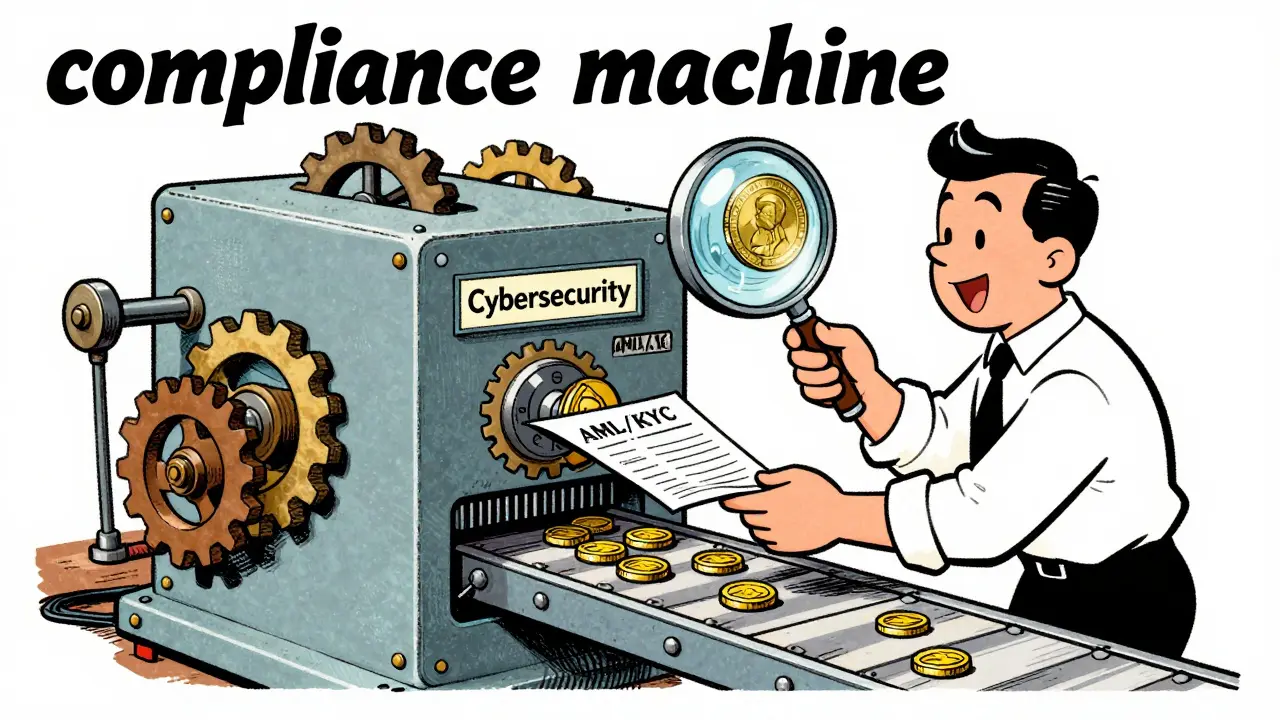
If you think a basic email verification is enough, think again. The Bank Secrecy Act provides the foundation for the AML (Anti-Money Laundering) and KYC (Know Your Customer) protocols you must implement. You'll need a dedicated compliance officer and a system that can flag suspicious transactions in real-time. Cybersecurity is where things get even more intense. The NYDFS demands "military-grade" protocols. This isn't just flavor text; it means you must comply with NYDFS Cybersecurity Regulation 500. Expect to conduct regular penetration testing and maintain a rigorous vulnerability management program. Moreover, since November 2023, the NYDFS has implemented strict guidance on coin-listing and -delisting. You can't just list every trending meme coin. You must prove the token's legitimacy, assess the risk of market manipulation, and ensure the asset doesn't violate securities laws before offering it to New Yorkers.
| Feature | New York (BitLicense) | Wyoming | Louisiana |
|---|---|---|---|
| Strictness | Very High | Innovation-Friendly | Moderate |
| Capital Thresholds | $1M - $5M+ | Low/Flexible | Moderate (Net Worth based) |
| Focus | Consumer Protection | Industry Growth | Basic Oversight |
| Entry Barrier | High (Prohibitive for startups) | Low | Medium |
The Cost of Entry: Is it Worth It?
Let's talk numbers. Applying for a BitLicense is an expensive gamble. The initial application fees and legal consulting can easily top $150,000 before you've even been approved. Once you're in, the annual maintenance-including surety bonds, audits, and compliance staff-can range from $15,000 to $80,000, and that's for a small operation. Large players like Coinbase have reportedly employed teams of 20-30 professionals just to keep their New York status active. So, why do it? Because New York is the financial heart of the world. Having a BitLicense is a powerful marketing tool. It tells institutional investors and high-net-worth individuals that you've passed the hardest test in the industry. Companies like Gemini and MoonPay have used this compliance as a competitive moat, effectively locking out smaller competitors who can't afford the overhead. On the flip side, some companies simply give up. Kraken famously exited the New York market, describing the license as a "creature so foul" that it wasn't worth the effort. If your business model relies on lean operations and rapid iteration, the BitLicense might be your biggest roadblock.

Practical Steps for the Application Process
If you've decided to go for it, don't just wing it. The NYDFS is not known for hand-holding. You will need a professional compliance consultant (charging anywhere from $200 to $500 per hour) and a legal team specializing in New York financial law. Here is the general roadmap you'll follow:
- Self-Assessment: Determine if your specific activities (custody, exchange, issuance) trigger the requirement.
- Build Your Infrastructure: Implement your AML/KYC and cybersecurity frameworks *before* applying. The NYDFS wants to see that the systems are already working.
- Prepare Documentation: You'll need a comprehensive business plan, a detailed capitalization plan, and a written AML program.
- Submit and Wait: Submit the application and enter the 12-18 month review window. Expect a lot of follow-up questions and requests for more data.
- Maintain Compliance: Once approved, you'll face periodic reporting requirements regarding transaction volumes, customer complaints, and any security incidents.
One pro tip: If the BitLicense feels too restrictive, look into a Limited Purpose Trust Company Charter. It's another way to operate legally in New York and offers similar oversight but can provide different operational benefits depending on your business structure.
Do I need a BitLicense if I'm based outside the US but have New York users?
Yes. The BitLicense applies to anyone engaging in virtual currency business activity involving New York residents, regardless of where the company is physically located. This is why platforms like Binance have historically restricted New York users from accessing their services.
How long does the application process actually take?
On average, it takes between 12 and 18 months. The timeline varies based on the complexity of your business model and how complete your initial documentation is.
What happens if I operate in New York without a BitLicense?
Operating without a license can lead to severe penalties, including heavy fines and cease-and-desist orders from the NYDFS. In extreme cases, it can lead to criminal charges for operating an unlicensed money transmitter.
Is there a minimum amount of money required to start?
Beyond the application and legal costs, you generally need a minimum of $1 million to $5 million in capitalization, plus a customer protection fund of at least $500,000.
Does the BitLicense cover all types of tokens?
It covers virtual currency activities, but the NYDFS has a specific approval process for which tokens can be listed. You must evaluate each asset for legitimacy and market risk according to the November 2023 guidance.
Next Steps and Troubleshooting
If you're a small startup, the BitLicense is likely too expensive. Your best bet is to either launch in a more friendly state like Wyoming or partner with an existing BitLicense holder to offer your services through their infrastructure. If you're an institutional player, start your documentation now. The 2025 Industry Letter from the NYDFS expanded blockchain analytics expectations to all covered institutions, meaning your technical requirements are higher than ever. Hire a compliance firm that has successfully navigated the NYDFS process specifically; general corporate law firms often underestimate the granularity of the BitLicense requirements.
Samson Selleck
April 9, 2026 AT 12:48The regulatory arbitrage here is palpable. By establishing such a high barrier to entry, the NYDFS isn't just protecting consumers; they're effectively creating an oligopoly for the few entities with the capital depth to absorb these operational expenditures. The systemic asymmetry ensures that any disruptive innovation is stifled by the sheer weight of compliance overhead before it can even challenge the incumbents. It's a classic case of regulatory capture masquerading as consumer safety.
Kelly Cantrell
April 10, 2026 AT 09:04Of course they want your KYC and everything. It's not about "protection" it's about tracking every single cent we move so they can freeze accounts whenever they feel like it. They just want a digital leash on everyone in the city
Typical government overreach if you ask me
Tracie and Matthew Hartley
April 10, 2026 AT 17:11why do peopel care about ny anyway like just move to wyoming lol its way easyer and less stressful
Rob Mitchell
April 11, 2026 AT 04:20Partnering with a license holder is a great shortcut for startups.
EDOZIEM MICHAEL
April 12, 2026 AT 15:09money is just a mirror of our desires and the law is a fence we build to feel safe in the dark
aletheia wittman
April 13, 2026 AT 03:08Srsly??? 1.5 million just to start?? That is literally insane!! Who has that kinda money just lying around to give to the govment 🙄 like omg just let us trade in peace!
Omotola Balogun
April 14, 2026 AT 17:02Actually, the capital requirements are quite standard for any Tier 1 financial jurisdiction. One must understand that the NYDFS is simply applying the Basel III principles to the digital asset space to prevent systemic colapse. Most people here don't realize that the liquidity buffers are there to protect the end user, not the state. Its a necessary evil for institutional adoption.
Chidinma Sandra okafor
April 16, 2026 AT 04:52Oh look, another way the US makes it impossible for anyone else to compete. So lovely how they just build a wall of money so only their precious little companies survive. Truly inspiring stuff
Akshay Gorad
April 17, 2026 AT 10:18I believe it's important to respect the local laws of each jurisdiction to ensure long-term stability for the industry.
7stargee Emmanuel Obani
April 18, 2026 AT 20:54Total scam lol. They just want to tax you and watch you fail 🤡
Carroll Foster
April 20, 2026 AT 11:36Imagine spending 18 months on a paper application in 2024. The absolute peak of efficiency right here! I'm sure the blockchain's decentralization is just thrilled about this centralized bureaucratic nightmare.
jennelle williams
April 21, 2026 AT 04:30it sounds scary but maybe it helps people feel safe
william manes
April 22, 2026 AT 14:14Get a real job 🇺🇸
Alan Seiden
April 22, 2026 AT 20:11Utter rubbish. New York thinks it's the center of the universe as usual. The British approach to regulation is far more balanced than this American madness. Absolute joke of a system.
ssjuul z
April 23, 2026 AT 21:12Let's just keep pushing forward! We can find a way to make this work for everyone! :D
Rima Dinar
April 25, 2026 AT 09:41If you are feeling overwhelmed by these requirements, please remember that it is a journey and not a race. You can take it one step at a time, perhaps by starting in a smaller market first and then scaling up as you acquire more capital and experience, which will make the transition to New York much smoother in the long run.
Hope Johnson
April 26, 2026 AT 16:12The tension between the fluidity of crypto and the rigidity of law is a fascinating study in human nature. We want the freedom of the new world but the security of the old one. It's almost as if we are afraid to truly let go of the centralized structures that defined the last century, and the BitLicense is simply the physical manifestation of that internal conflict we all feel when we invest in these assets.
Agnessa Dale
April 28, 2026 AT 12:37I'm sure there are still plenty of opportunities for those who persevere!
Will Dixon
April 28, 2026 AT 20:32just get a partner who alreedy has the license man its way easier
Terrance Hausmann
April 30, 2026 AT 09:59I totally hear you guys. It's a lot to take in and can feel like a mountain in your way, but remember that every big company today started somewhere and had to deal with some kind of red tape, so don't let the fear of the paperwork stop your dream of building something awesome for the community.
Rob Mitchell
May 1, 2026 AT 21:32That's the way to do it.