

Whether you're a startup or an established global platform, the rules are shifting. As of April 2026, we have moved past the basic "fiat-to-crypto" requirements into a much broader era of oversight. You need to know exactly what's required to keep your business legal and your assets safe.
Who Actually Needs to Register?
For a long time, AUSTRAC only cared if you were swapping "real" money (fiat) for digital coins. But the landscape changed on March 31, 2026. Now, the net is cast much wider. You must register if your business provides any of the following services:- Exchanging fiat currency for digital currency (and vice versa).
- Exchanging one digital currency for another (crypto-to-crypto).
- Transferring digital assets on behalf of your clients.
- Providing custody or management services for digital assets.
- Offering financial services related to the issuance or sale of coins, such as Initial Coin Offerings (ICOs).
The Pre-Registration Hurdle
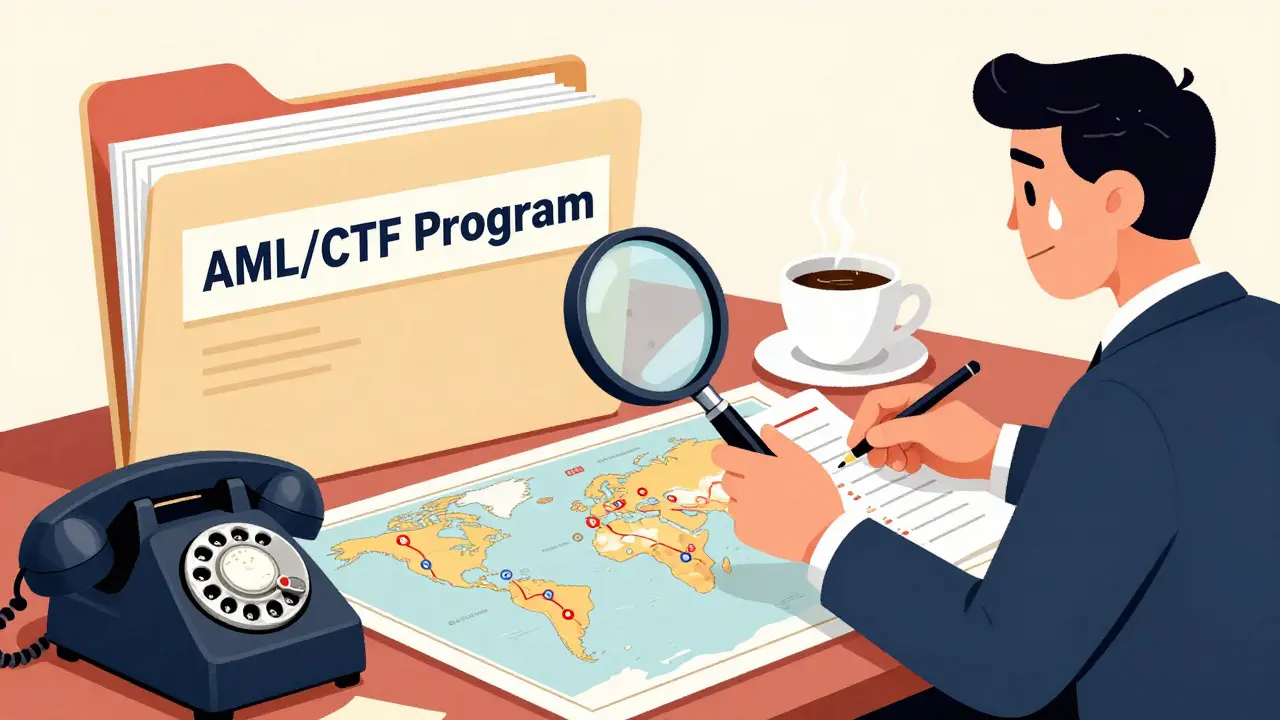
Many founders make the mistake of thinking registration is just a form you fill out and a fee you pay. It's not. Before you even hit the "submit" button on your application, you need to have two critical documents ready. If AUSTRAC asks for them and you don't have them, your application will likely be rejected.First, you need a comprehensive AML/CTF Program. This is a living document that outlines exactly how your business will prevent money laundering and terrorism financing. It isn't a generic template; it must be tailored to your specific platform's risks. Second, you need a Money Laundering/Terrorism Financing (ML/TF) Risk Assessment. This is where you prove you've thought about the "worst-case scenarios"-like high-risk jurisdictions or anonymous whales-and have a plan to mitigate those risks.
Step-by-Step Registration Process
Getting registered requires a methodical approach. Don't wing it, as AUSTRAC has broad discretionary powers to refuse or cancel registrations if they feel your risk management is sloppy.- Internal Audit: Identify every touchpoint where a user interacts with assets. Determine if you are providing exchange, custody, or transfer services.
- Document Preparation: Draft your AML/CTF Program and Risk Assessment. Most firms hire compliance consultants like Zitadelle AG or Xenia Compliance to ensure these meet the strict standards of the AML/CTF Act.
- Application Submission: Collate your supporting documents and submit the formal application via the AUSTRAC portal.
- Review Period: Wait for AUSTRAC to review your submission. Be prepared for "Request for Information" (RFI) emails where they ask you to clarify your internal controls.
- Activation: Once approved, you'll receive your registration number. Only then can you legally offer DCE services in Australia.
Ongoing Compliance: Life After Registration
Registration is the starting line, not the finish line. Once you're on the register, you're under a microscope. The most critical part of your daily operation will be your KYC procedures. You cannot allow anonymous transactions. You must implement robust identity verification to ensure every user is who they say they are. Beyond KYC, you have reporting obligations. You can't just keep a ledger for yourself; you must report suspicious activities and large transactions directly to AUSTRAC. This requires automated monitoring tools that can flag unusual patterns-like a sudden surge of small deposits from multiple offshore accounts followed by one giant withdrawal.| Feature | AUSTRAC Registration | ASIC AFSL |
|---|---|---|
| Primary Goal | Stop crime (AML/CTF) | Consumer & Market Protection |
| Mandatory For | All Digital Currency Exchanges | Tokenized securities/derivatives |
| Core Focus | Identity & Transaction Flow | Capital adequacy & Disclosure |
| Penalty for Lack of | Criminal offense | Civil penalties / banned trade |
The Difference Between AUSTRAC and ASIC
There is often a lot of confusion between needing an AUSTRAC registration and an Australian Financial Services License (AFSL) from ASIC. Think of it this way: AUSTRAC is about *who* the money is and *where* it's going. ASIC is about *what* the product is and *how* it's sold. If you are simply swapping Bitcoin for Ethereum, AUSTRAC is your main concern. However, if you launch a product that looks like a security-such as tokenized real estate or complex derivatives-you've entered ASIC's territory. An AFSL brings much heavier burdens, including strict capital requirements and detailed disclosure obligations. Many exchanges start with AUSTRAC and only pursue an AFSL when they expand their product line into regulated financial instruments.
Common Pitfalls and How to Avoid Them
Many exchanges fail not because they have bad tech, but because they have bad paperwork. One common mistake is using a "template" AML program. AUSTRAC hates generic documents. They want to see that you've analyzed the specific risks of *your* user base and *your* specific coin pairings. Another trap is neglecting the Australian Consumer Law. Even if you are perfectly compliant with AUSTRAC's reporting rules, you can still be sued or fined if your marketing is misleading. If you promise "guaranteed returns" or hide the risks of volatility in your Terms of Service, the ACCC will come knocking regardless of your registration status. Finally, don't ignore the global context. Australia's shift in March 2026 was designed to align with the Financial Action Task Force (FATF) standards. This means if you're already compliant with strict EU or US regulations, you're halfway there, but you still need to map those processes to the specific wording of the Australian AML/CTF Act.Is AUSTRAC registration the same as a license to operate a crypto exchange?
No. AUSTRAC registration is specifically for AML/CTF compliance. It doesn't provide a "general license" to operate a financial business. Depending on the assets you trade, you may still need an AFSL from ASIC for certain financial products.
What happens if I start operating before my registration is approved?
Operating a digital currency exchange without registration is a criminal offense in Australia. You risk heavy fines and potential imprisonment, and AUSTRAC may publish your name as an entity subject to enforcement action, which effectively kills your reputation in the market.
Do I need to register if I only do crypto-to-crypto trades?
Yes. As of March 31, 2026, the scope of registration expanded. Exchanging one digital currency for another now requires AUSTRAC registration, moving away from the old fiat-only requirement.
How often do I need to update my AML/CTF program?
Your program should be a living document. While there isn't a fixed calendar date for every update, you must review and update it whenever there is a significant change in your business model, a change in the law, or after a periodic independent review (which is typically required every few years).
What are the most important documents for the application?
The two non-negotiables are a detailed AML/CTF Program and a comprehensive ML/TF Risk Assessment. These documents must demonstrate that you understand how your platform could be abused for crime and what specific controls you have in place to stop it.
Iestyn Lloyd
May 1, 2026 AT 19:17It is worth noting that the mapping of EU MiCA standards to the Australian framework is surprisingly straightforward, though the reporting intervals differ slightly.
Ralph Espinosa
May 1, 2026 AT 22:45Spot on!! The distinction between AUSTRAC and ASIC is where most people trip up!!! Definitely keep an eye on those RFI emails because they can be brutal if you aren't prepared!!!
Emily A
May 3, 2026 AT 09:37Using a template for an AML program is the pinnacle of laziness. One would assume a serious business owner understands that a risk assessment is a bespoke document, not a fill-in-the-blank exercise.
Arun Prabhu
May 4, 2026 AT 05:06Imagine thinking a simple PDF can stop global money laundering. Truly comical. The sheer banality of these regulatory hurdles is enough to make any real intellectual weep for the state of decentralized finance.
Chloe Fletcher
May 5, 2026 AT 05:51This is so helpful! 🌟 Definitely a wake-up call for anyone trying to stay under the radar! 🚀
VIVEK SINGH
May 5, 2026 AT 06:14Oh, sure, let's just trust the government to 'manage' the blockchain. Because if there's one thing bureaucrats are known for, it's their innate understanding of cryptographic hashes. Pure brilliance. 🙄
Lex Harley
May 6, 2026 AT 11:05Wait, so if i'm just runnin a p2p swap bot without a front-end, do i still hit the dce definition? The liquidity providr aspect feels like a gray area here, esp with the new 2026 regs. My stack is mostly solana-based and the custody part is handled by a third party api so maybe im overthinking the risk vectors.
Lloyd I
May 7, 2026 AT 04:01I completely agree with the approach of doing a gap analysis first! It's the best way to make sure no one is left behind in the compliance process. We can all get through this by helping each other out!
Tony Phan
May 7, 2026 AT 10:33LMAO the RFI emails are a nightmare! Total compliance bloat. My last project got hammered on the KYC flow because the auditor didn't get the ZK-proof logic. Absolute waste of time!
Robert Smith
May 8, 2026 AT 00:43Too much paperwork 😴
Kristi Swartz
May 9, 2026 AT 06:01The law is the law. If you cannot follow basic registration rules you should not be in business
Alex Mazonowicz
May 10, 2026 AT 07:39This is a great guide!!! I'm sure plenty of startups will find this incredibly useful for their launch!! Keep it up!!!
Arti Jain
May 11, 2026 AT 15:03Pathetic. Only a few of us actually understand the true scale of this.
Harvey Alford
May 13, 2026 AT 05:30My business failed because of this stuff. Miserable.
Felix Eduardo Velasquez
May 13, 2026 AT 20:28The shift toward FATF alignment is an inevitable evolution. While the friction of registration is high, the systemic stability it brings to the institutional entry point is the only way the industry matures. It's a trade-off between the anarchy of the early days and the legitimacy required for mass adoption. If we want the big pension funds to move in, we need the regulators to be satisfied. The 'criminal offense' part is a heavy stick, but it's designed to clear the chaff from the wheat. Only the serious players will survive the 2026 transition. It's a filter, not just a hurdle.
Gabby Puche
May 15, 2026 AT 15:16Good luck everyone! ✨ You've got this! 💖
Lynne Teperman
May 15, 2026 AT 18:05such a wild ride watching the regs shift like sand under our feet. just gotta keep swimming through the bureaucracy i guess
Rachel S
May 16, 2026 AT 16:30I've seen so many founders try to dodge this by registering in the Seychelles, but AUSTRAC isn't playing games anymore. If you have Australian users, you are in their crosshairs. It's absolutely terrifying how fast they can freeze accounts if they suspect non-compliance! 😱
Gabrielle Danis
May 17, 2026 AT 01:42The distinction between a digital currency exchange and a financial product is the crux of the entire regulatory framework in Australia. One must be meticulous in classifying their token utility to avoid the AFSL trap.
Mitali Rajvanshi
May 17, 2026 AT 02:17This is a very clear breakdown. Thanks for sharing.
April D Thompson
May 17, 2026 AT 17:25Oh my god, the drama of it all! Imagine the absolute chaos of a government raid because you forgot a few pages of a risk assessment! It's practically a tragedy in the making! We're all just souls dancing on the edge of a regulatory volcano, trying to find some shred of peace in a world of KYC and AML! Let's just embrace the madness and hope the blockchain gods have mercy on our poor, fragmented spirits! 🌋✨
Bevon Findley
May 19, 2026 AT 16:13Basically a tax on entry. :)
Veronica Bago
May 19, 2026 AT 23:22Seems like a lot of work but better than going to jail!