
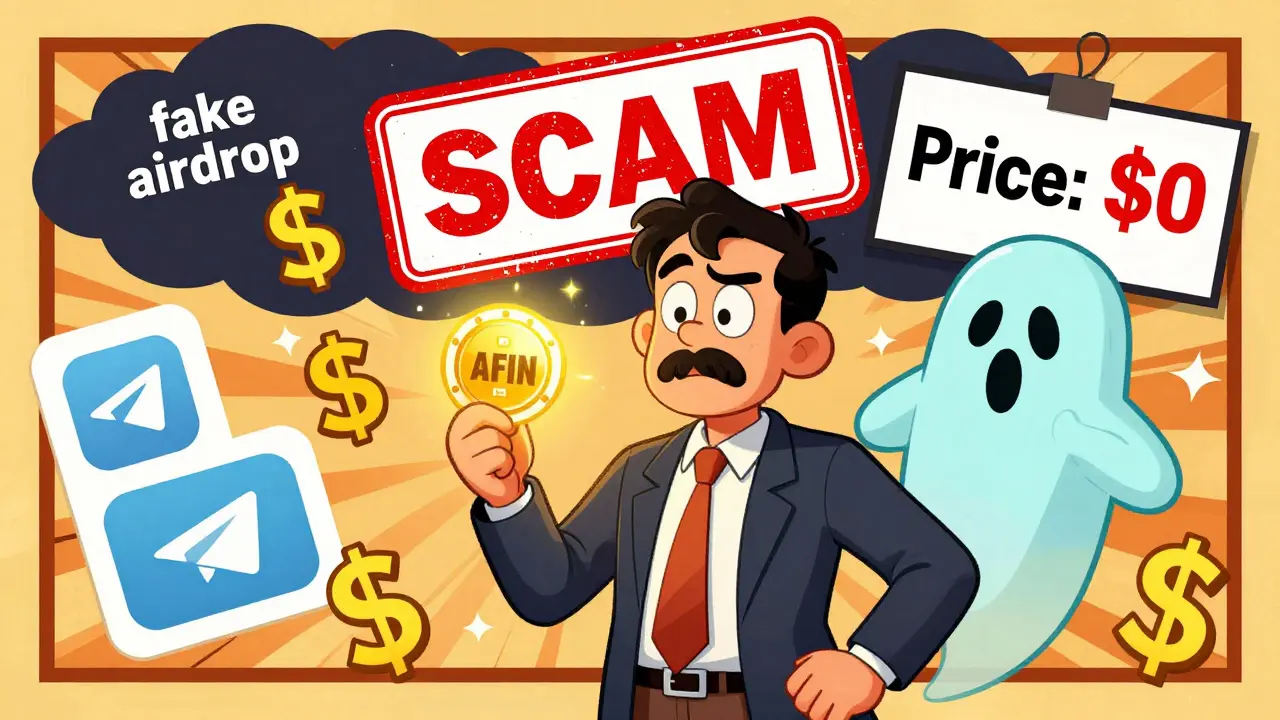
There’s a lot of talk online about an Asian Fintech (AFIN) airdrop. You’ve probably seen ads, Telegram groups, or Reddit threads promising free tokens if you sign up, connect your wallet, or share the project. But here’s the truth: there is no verified, official AFIN airdrop-at least not one that’s been announced on credible platforms like CoinMarketCap, Binance, or the project’s own official channels.
Let’s cut through the noise. If you’re considering jumping into this, you need to know what’s real, what’s fake, and what you’re really signing up for. This isn’t about hype. It’s about protecting your time, your wallet, and your crypto assets.
What Is Asian Fintech (AFIN)?
Asian Fintech (AFIN) is a cryptocurrency project that claims to combine blockchain technology with environmental responsibility. It says it’s a "cryptocurrency with a conscience." The idea is simple: use clean energy for mining. AFIN ties itself to something called Green Bitcoin, which supposedly runs on solar, wind, and hydro power instead of the energy-hungry methods used by Bitcoin and some other coins.
The token has a fixed supply: 500 million AFIN total. Only about 135 million are currently in circulation. That might sound promising, but supply alone doesn’t mean value. The real question is: is anyone actually trading it?
Its smart contract address is listed as 0xee9e...f67a72. That’s a technical detail, but if you’re planning to interact with it, you’ll need to verify it yourself on a blockchain explorer like Etherscan or BscScan. Never trust a link someone sends you. Always type the address yourself or copy it from the official website-if you can find one.
The Price Puzzle: $0.0012 or $0?
This is where things get messy. Different sites show wildly different prices for AFIN.
CoinCodex says AFIN is trading at $0.001218 USD. It even predicts it could hit $0.001418 by April 2025. That’s a 16% jump. They also claim a $1,000 investment today could turn into $1,607.50 by May 2025. Sounds great, right?
But then you check Binance. Or CryptoRank. Or CoinMarketCap. And guess what? They all say the price is $0. Trading volume? Zero. Market cap? $0. No listings. No buyers. No sellers.
Why the gap? Because AFIN isn’t listed on any major centralized exchange. It’s not on Binance, Coinbase, Kraken, or KuCoin. That means you can’t just log in and buy it like you would with Bitcoin or Ethereum.
The only way to get AFIN right now is through decentralized exchanges (DEXs) like PancakeSwap or Uniswap-but only if you connect your Web3 wallet and find a liquidity pool for it. And even then, you’re dealing with extremely low volume. That means your trade could fail, or you could get stuck with tokens that no one else wants.
Why There’s No Official Airdrop
Here’s the most important part: no credible source confirms an AFIN airdrop exists. Not CoinMarketCap. Not the project’s official website (if it even has one). Not their Twitter, Telegram, or Discord.
When legitimate projects run airdrops, they announce them clearly. They list eligibility rules. They show distribution dates. They verify token claims on-chain. They even have third-party audits.
AFIN does none of that.
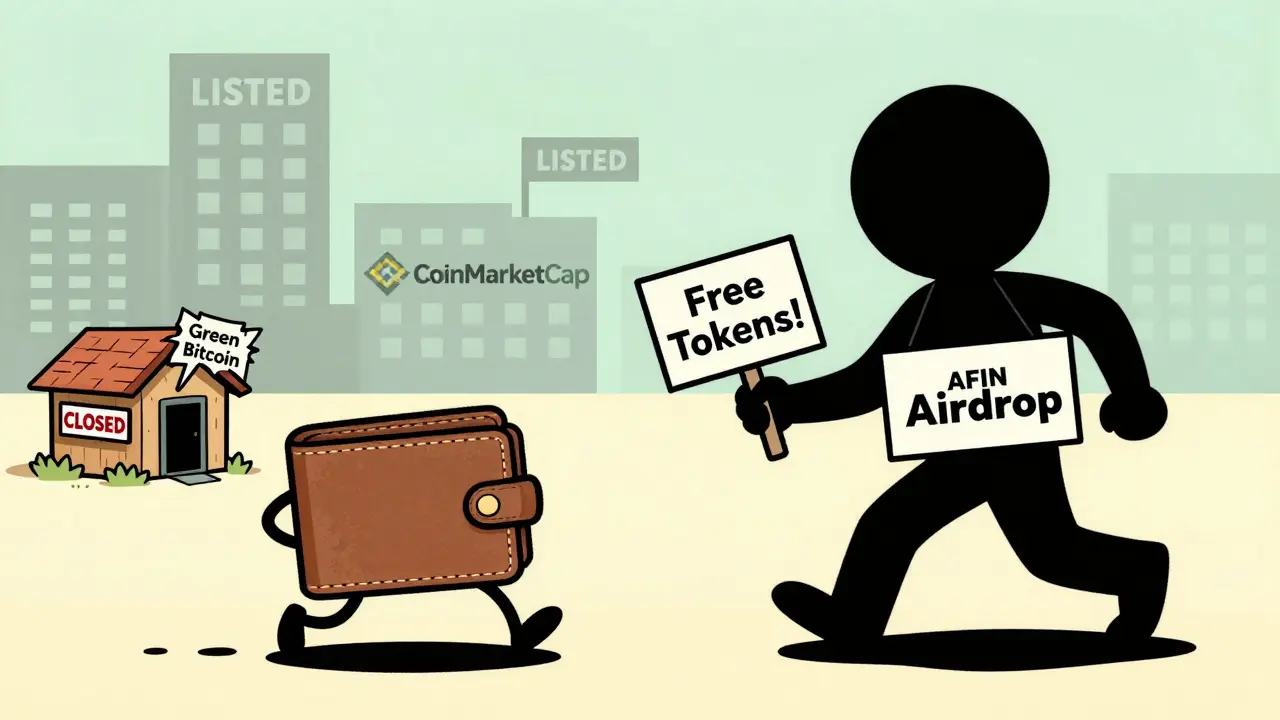
Instead, you’ll find random blogs, YouTube videos, and Telegram bots saying, "Join now, get 5,000 AFIN for free!" Those aren’t announcements-they’re scams. They’re designed to trick you into connecting your wallet, giving away private keys, or paying a "gas fee" to claim your tokens. Once you do that, your funds vanish.
There’s no record of AFIN ever running a verified airdrop. Not in 2023. Not in 2024. Not in 2025. And as of February 2026, there’s still no proof one is happening.
What About the Historical Price?
Some sites mention AFIN hit a peak of ₹32.12 (about $0.38 USD) back in January 2019. That’s over five years ago. What happened since then? Nothing much. No major updates. No new team announcements. No product launches. No audits.
That kind of price spike in 2019 likely came from early speculation or a pump-and-dump scheme. Tokens that peak years ago and then go quiet rarely come back with real value. The market remembers. And right now, the market is ignoring AFIN.
Is AFIN Sustainable? Or Just Saying It Is?
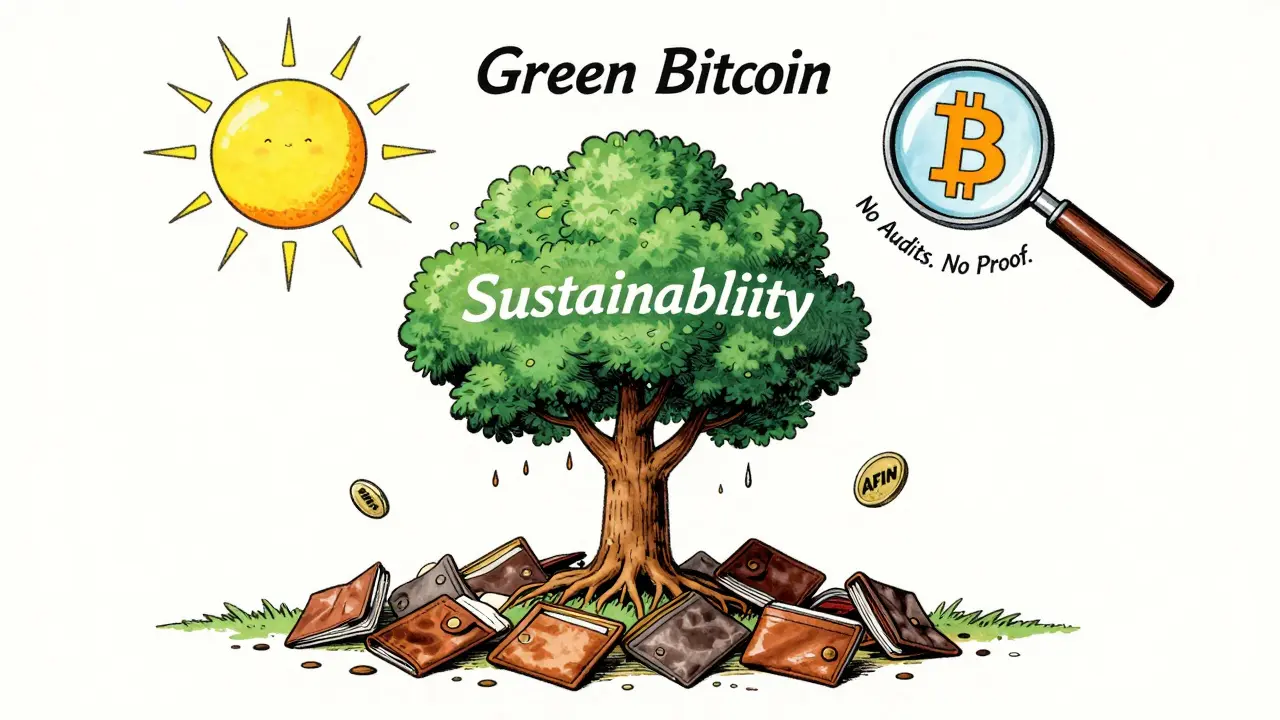
AFIN claims to be eco-friendly because it ties into Green Bitcoin, which supposedly uses renewable energy. That sounds good. But here’s the catch: there’s no public proof.
Where are the energy reports? The solar farm partnerships? The carbon offset certificates? Who audits their mining operations?
Most projects that truly care about sustainability-like Chia or Algorand-publish detailed reports. They show data. They get third-party verification. AFIN doesn’t. And without that, "green" is just a marketing word.
It’s like a car company saying their SUV is "climate-friendly" because they planted a tree. Without proof, it’s not a claim-it’s a slogan.
Where Can You Buy AFIN? (And Should You?)
If you’re still determined to get AFIN, the only option is a decentralized exchange. You’ll need:
- A Web3 wallet like MetaMask or Trust Wallet
- Some BNB or ETH to pay for gas fees
- The exact AFIN contract address (double-checked)
- A DEX that supports the token (likely on Binance Smart Chain)
Even then, you’re entering a market with almost zero liquidity. You might be the only buyer. Or worse, you might be buying from a fake pool created by scammers.
And here’s the kicker: if you do buy AFIN, you won’t be able to sell it easily. No exchange will list it. No ATM will accept it. No merchant will take it. You’re holding a token with no real use case and no buyers.
Red Flags You Can’t Ignore
Here’s a quick checklist of warning signs:
- Price listed as $0 on Binance, CoinMarketCap, and CryptoRank
- No official website with clear team info or whitepaper
- Only social media posts from anonymous accounts
- Airdrop claims with no official announcement
- Pressure to act fast: "Limited spots!" "Hurry before it’s gone!"
- Requests to connect your wallet or send crypto to claim "free" tokens
If any of these apply, walk away.
What Should You Do Instead?
If you’re looking for sustainable crypto projects with real traction, look at:
- Chia (XCH) - Uses proof-of-space-and-time, no mining farms
- Algorand (ALGO) - Carbon-neutral consensus mechanism
- Cardano (ADA) - Has published environmental impact reports
These projects have transparent teams, active development, and real exchange listings. They don’t need to promise free tokens to get attention.
And if you’re after airdrops? Stick to projects with proven track records: Polygon, Solana, or Cosmos have all run legitimate airdrops in the past. They don’t hide behind vague claims or zero trading volume.
Final Verdict
Asian Fintech (AFIN) isn’t a scam in the traditional sense. There’s no fake app or stolen code. But it’s also not a real investment. It’s a ghost project. A token with no exchange presence, no liquidity, no team transparency, and no verified airdrop.
Don’t fall for the hype. Don’t connect your wallet to unknown sites. Don’t send crypto to claim "free" AFIN. And don’t believe price predictions from sites that can’t even agree on whether the token is worth $0 or $0.0012.
Right now, the safest choice is to ignore AFIN completely. There’s nothing here worth risking your money on.
Danny Kim
February 27, 2026 AT 04:26Michael Rozputniy
February 28, 2026 AT 16:53Cathy Sunshine
February 28, 2026 AT 19:59Shannon Black
March 1, 2026 AT 06:41Richard Cooper
March 2, 2026 AT 00:44Michael Teague
March 2, 2026 AT 08:02kati simpson
March 3, 2026 AT 02:03Cory Derby
March 3, 2026 AT 10:47Colin Lethem
March 4, 2026 AT 07:19lori sims
March 5, 2026 AT 10:39Kristi Emens
March 5, 2026 AT 14:09Michelle Mitchell
March 6, 2026 AT 21:48christopher luke
March 8, 2026 AT 13:56Mary Scott
March 10, 2026 AT 12:14Shannon Holliday
March 11, 2026 AT 15:06Michelle Xu
March 12, 2026 AT 08:43Ryan Burk
March 14, 2026 AT 03:32Sriharsha Majety
March 15, 2026 AT 07:35Tabitha Davis
March 16, 2026 AT 10:05Vishakha Singh
March 17, 2026 AT 05:36Arya Dev
March 19, 2026 AT 02:14Leslie Cox
March 19, 2026 AT 11:51Andrew Hadder
March 20, 2026 AT 19:57Cory Derby
March 22, 2026 AT 18:53