
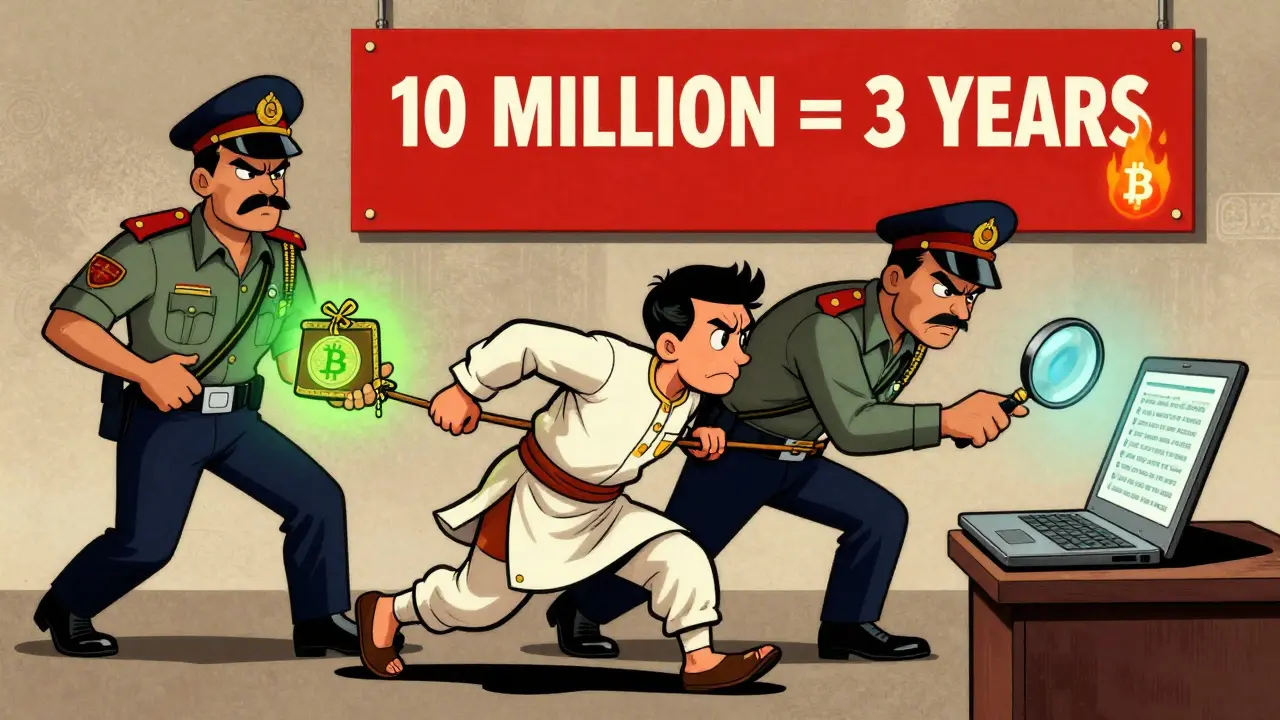
In Nepal, making a cryptocurrency transaction over 10 million Nepalese Rupees (roughly $74,000 USD) can land you in prison for three years. Not a fine. Not a warning. Not a freeze on your account. Actual jail time. And it doesn’t matter if you’re buying Bitcoin, sending crypto to family abroad, or mining Ethereum in your basement. If the transaction crosses that threshold, the law treats it like a serious crime.
This isn’t a rumor. It’s written into Nepal’s Foreign Exchange (Regulation) Act, 1962 a law that bans all unauthorized foreign currency transactions, including cryptocurrency. Section 12 of this law specifically says any transaction involving 10 million NPR or more triggers mandatory imprisonment for up to three years. On top of that, the government can seize everything tied to the transaction-your laptop, your phone, your crypto wallet, even cash you had in your bank account. No trial, no leniency, no exceptions.
How the Law Actually Works
The Nepali government doesn’t just say "don’t use crypto." They’ve built a whole legal machine to catch and punish people who do. The Nepal Rastra Bank (NRB) the central bank that enforces financial rules in Nepal issued the first official ban in 2017, but it wasn’t until 2022 that enforcement became aggressive. That’s when police started raiding homes, seizing devices, and filing criminal charges under multiple laws at once.
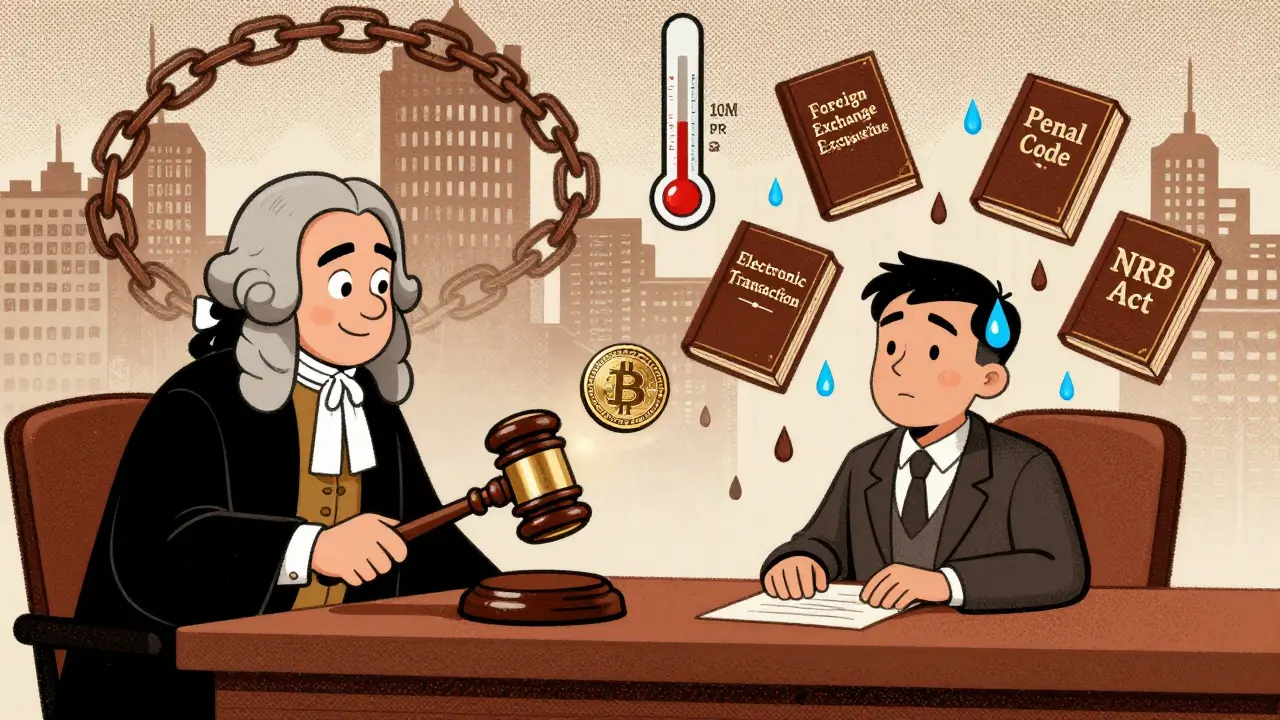
The legal trap is layered. If you send $10,000 in Bitcoin to a relative in the U.S., you’re breaking:
- Foreign Exchange (Regulation) Act for unauthorized cross-border transactions
- Electronic Transaction Act for digital payments without authorization
- National Penal Code for financial misconduct
- Nepal Rastra Bank Act for violating central bank directives
Prosecutors don’t pick one. They use them all. That means you’re not just facing one charge-you’re facing four, each with its own penalties. And if you can’t pay the fine (which can be up to three times the transaction amount), you go to jail anyway.
Who Gets Targeted-and Why
You might think this law targets big-time traders or crypto millionaires. But that’s not what’s happening.
According to reports from the Central Investigation Bureau (CIB) Nepal’s police unit that handles financial crimes, over 87% of cases in 2023 involved transactions under $10,000. One man was jailed for sending $5,200 to his sister in Dubai. A student was arrested for buying $3,000 worth of Bitcoin to pay for online courses. Even remittances-money sent home by Nepali workers abroad-aren’t safe.
Why? Because the law doesn’t care about intent. If you used crypto to move money, even if it was to avoid bank fees or because your family needed help, you’re still breaking the law. The government claims crypto is fueling capital flight and money laundering. In 2021, they said $20.8 million left Nepal through crypto channels. But experts point out: that’s less than 1% of total remittances. Still, the punishment is the same whether you moved $100 or $1 million.
How Police Find You
Getting caught isn’t hard. Nepal’s police have become surprisingly tech-savvy. When someone is suspected of crypto use, they don’t just ask questions. They show up with forensic tools.
From the CIB Annual Report 2023 official police documentation on crypto enforcement, here’s how it works:
- Police seize your phone, laptop, or external hard drive on the spot.
- They use software like Cellebrite UFED a digital forensics tool used to extract crypto wallet data to pull out wallet addresses, transaction histories, and private keys.
- They trace the blockchain to find where the money came from and where it went.
- They calculate the value of the crypto at the time of seizure-not when the transaction happened. This lets them inflate the amount to meet the 10 million NPR threshold.
One case from 2022 involved a man who sent 0.2 BTC (worth $7,800 at the time). Police seized his laptop, found the transaction, and calculated the value of Bitcoin at its peak that week: $41,000 per coin. That pushed the total to over $8 million-well above the 10 million NPR limit. He got three years.

What Happens After Arrest
Once you’re arrested, the system moves fast-and it’s stacked against you.
You’ll be held for up to 25 days without charge, or 90 days if they claim it’s linked to money laundering. During that time, police will try to force you to unlock your devices. If you refuse, they can charge you with obstruction. If you give them access, they’ll use it to build a case against you.
Most defendants don’t have lawyers who understand crypto. In fact, 78% of people charged don’t even have legal representation specialized in digital finance. That means judges often rely on police reports alone. And since there are no official guidelines for how to investigate crypto cases, every arrest is handled differently.
Some judges apply the 10 million NPR threshold strictly. Others ignore it. One man in Kathmandu got two years for a 5.2 million NPR transaction-half the legal limit-because the judge called it "aggravating circumstances." Another got off with a fine because his lawyer argued the value was calculated wrong. There’s no consistency. Just fear.
Why Nepal’s Law Is So Extreme
Compared to other countries, Nepal’s approach is brutal.
China bans crypto trading but doesn’t jail individuals. India taxes crypto gains at 30% but lets people trade legally. Thailand and Singapore created licensing systems for exchanges. Nepal? No licenses. No exceptions. Just jail.
The government says it’s protecting the economy. They claim crypto caused $20.8 million in illegal forex outflows in 2021. But the real issue? Nepal’s banking system is weak. The official exchange rate is outdated. Sending money through banks costs 1% in fees-and takes days. Crypto is faster, cheaper, and more reliable for millions of Nepalis who rely on remittances.
Instead of fixing the system, the government chose to punish the people using it.
What’s Changing? (And What Isn’t)
There are signs the law might soften. In early 2024, some judges started reducing sentences for transactions under the 10 million NPR threshold, citing human rights principles. The Supreme Court is reviewing a constitutional challenge arguing that the law violates the right to economic freedom.
But enforcement hasn’t slowed. In March 2024, the CIB arrested nine people for crypto transactions totaling $85,000-even though each individual transaction was below the 10 million NPR limit. The government’s message is clear: we’re not backing down.
Meanwhile, the ban is pushing crypto use underground. Chainalysis estimates 210,000 Nepalis still use crypto, mostly through peer-to-peer apps and cash-based trades. The more the government cracks down, the more creative people get. And the more people get caught.
What This Means for You
If you’re in Nepal and you’ve ever used crypto-even once-you’re at risk. You don’t need to be rich. You don’t need to be a trader. Just one transaction over 10 million NPR, or even one that’s misreported by police, can change your life.
There’s no safe way to use crypto in Nepal right now. No legal exchanges. No protected remittance channels. No exceptions for family, education, or emergencies. The law doesn’t care why you did it. Only that you did it.
For now, the only advice is simple: avoid crypto entirely. Don’t send it. Don’t receive it. Don’t even look at it. Because in Nepal, the price of a single transaction might be three years of your life.
Is it illegal to own cryptocurrency in Nepal?
Yes. Nepal bans all cryptocurrency activities, including owning, trading, mining, and receiving crypto. The law doesn’t distinguish between holding and transacting. Simply having crypto in a wallet can lead to asset seizure and criminal investigation.
Can you get arrested for sending less than 10 million NPR in crypto?
Yes. While the law sets 10 million NPR as the threshold for mandatory three-year imprisonment, police often use overlapping laws to charge people for smaller amounts. In practice, transactions as low as $5,000 have led to arrests and jail time, especially if the police inflate the value using peak market prices.
What happens to your crypto wallet if you’re arrested?
Your entire wallet is seized. Police don’t just take the device-they demand access to private keys. If you refuse, you can be charged with obstruction. If you comply, they freeze the funds and treat them as forfeited property. Even if the transaction was legal under another country’s law, Nepal considers it stolen or illegal.
Are there any legal alternatives to crypto for remittances in Nepal?
Officially, yes-banks and licensed money transfer services like Western Union or MoneyGram. But they’re slow, expensive (up to 1% fee), and often require paperwork that many workers abroad can’t provide. This gap is why crypto remains popular despite the risks.
Is there any hope for legal reform in Nepal?
There are signs of change. Judges are beginning to apply proportionality in sentencing, and the Supreme Court is reviewing whether the law violates constitutional rights. However, the central bank insists the ban will remain until they can fully monitor crypto flows. Real reform is unlikely before 2025, and even then, it may only introduce taxation-not legalization.
Brittany Meadows
February 12, 2026 AT 13:48Santosh kumar
February 14, 2026 AT 06:09Will Lum
February 14, 2026 AT 19:23Elijah Young
February 15, 2026 AT 16:23Donna Patters
February 16, 2026 AT 22:52Michelle Cochran
February 18, 2026 AT 09:59monique mannino
February 19, 2026 AT 10:34Lindsey Elliott
February 20, 2026 AT 14:37blake blackner
February 21, 2026 AT 03:27Elizabeth Choe
February 22, 2026 AT 07:49Crystal McCoun
February 22, 2026 AT 13:12Ace Crystal
February 22, 2026 AT 16:49Tammy Chew
February 23, 2026 AT 21:31Claire Sannen
February 25, 2026 AT 01:21Peggi shabaaz
February 26, 2026 AT 18:30SAKTHIVEL A
February 27, 2026 AT 12:37krista muzer
February 27, 2026 AT 13:17Andrea Atzori
February 27, 2026 AT 16:07Joe Osowski
February 28, 2026 AT 17:17Gaurav Mathur
February 28, 2026 AT 22:11Jeremy Lim
March 2, 2026 AT 01:50Beth Trittschuh
March 2, 2026 AT 04:44Ekaterina Sergeevna
March 3, 2026 AT 18:40Christopher Wardle
March 4, 2026 AT 18:55Sanchita Nahar
March 5, 2026 AT 23:27Sakshi Arora
March 6, 2026 AT 06:09bala murali
March 6, 2026 AT 22:51Kaz Selbie
March 7, 2026 AT 23:35